Saturday, 27 July 2013

From Bonded Labour to Shreelanka

18 July 2000
Nepal bans bonded labour

The Nepalese government on Monday banned the practice of bonded labour, 
under which the lower caste people work in large farms owned by upper caste land owners.
Anyone violating the ban could be jailed up to 10 years.
Lower caste people have worked as bonded labors for generations,
trying to pay off the debts incurred by their fathers or grandfathers.
 _________

13 Years ago (almost to the day) the Nepalese government banned bonded labour – a good thing – but simultaneously thousands of people were left homeless. The government allocated land to many of these families and one of the communities they chose for about 250 families, is the village of Shreelanka in the Kailali District of western Nepal.

This is good agricultural land, (the surrounds are green with paddy fields) but for many years no one wanted to live here for three reasons: (1) Malaria and a lack of medicine to combat it, (2) annual floods, and (3) snakes. And so it was in Shreelanka that today we visited families that have once again been impacted by floods. Last weekend the water burst the banks of the nearby river, drowned their paddy and was three feet up their walls.

I sit on a wooden ‘day bed’ in a mud/straw house where a family of eight live. The eldest of four sisters is a sponsored child and is at school today for extra tuition, the other sisters, two brothers and Mum and Dad tell us that they know when the floods are coming now: if it has been raining hard a for a good while in the mountains on the horizon they know it will not be long.

They take the three beds in the single room house and stack them on top of the day bed and pack all their belongings onto the tower they have created. They take their two cows and move them to higher ground at the school. The kids move to the school as well. Mum and Dad climb the tower and stay in the house, trying to save as much as they can – for three days.

Today, the water has receded from the houses but the area around the house is a muddy swamp. (Some houses are still islands.) But their house is set-up again, Dad has rebuilt the fire pit and the second eldest daughter is helping Mum fry some vegetable for lunch. One side wall is completely destroyed by the flood, it is closed in by pieces of plastic and cloth; about two feet of most of the other walls has been eroded as well – but none of this can be repaired until after September when the monsoon is over and they can buy straw.

Life is tough for these families, but Mum and Dad smile as they tell us that they would rather this: their freedom – the ability to choose what work they do and who they do it for and the opportunity their kids now have to go to school and maybe escape the area - to the life of servitude and bondage that was theirs not all that long ago.

[On the way out of the village our vehicle ‘fell’ into a deep hole created by the floods and we had to trek out to the main road. It was quite a fun event for the locals!]

Thursday, 25 July 2013

Kali the Untouchable

It had been pouring for six hours when, after bouncing and sliding along a rocky, muddy track in our four wheel drive, we came to the swollen stream. Normally the crossing isn't a problem in this area, but today both sides of the river bank were crowded with people sheltering under umbrellas watching the water. Our driver got out and waded into the river, meeting a truck driver from the other side half way to discuss the challenge. It turns out it was really no challenge at all, and soon we were bouncing along the track on our way again.

We were on our way to a community about an hour from Dhangadhi where there is a community that is by geography remote and by caste isolated. The majority of people living in this area are Dalit by caste, and although the official Nepali line is that there is no caste discrimination, for the people of Kailali prejudice, discrimination and segregation are very real.

The categories by which people are defined and treated are numerous, including ethnicity, religion, gender and caste. There are the indigenous Nepalese, (our driver was from this category) who are at the bottom of the value chain ethnically. Then there are the Dalits, the lowest of castes and often referred to as the untouchables.

Kali is Dalit and a girl. Through no fault of her own, born into a caste that means that (traditionally) she will always be discriminated against – because of both her caste and her gender. Destined for service or for a continuing struggle for survival she will do it tough, like her Mum. But there is some hope – Kali is a sponsored child.

There is a family in Western Australia who has made a commitment to support her – she proudly showed me a photo of them and a letter from them. As a result, Kali is the first in her family to be able to go to school, and she loves it. With her Mum (and some others in tow) she showed me her classroom and told me about her teacher.

Because of the sponsorship funds that come to Kali and about 2,030 other sponsor children in this region, there are 697 families, (including Kali’s) that now have a water sealed latrine. There are 60 Child Clubs that operate, raising awareness among children and parents about child rights. There are a decreasing number of children reported to be undernourished. There are over 4,000 women and mums who are shareholders in local village level cooperatives which has resulted in increases in household income, increased school attendance, and decreased childhood diseases.

As Kali cautiously sits next to me (but not too close) on the hard wooden school bench, her eyes look down at the floor and she describes for me her dream to be a teacher and a mum. I remember the example of my best friend and I reach out my hand and softly place it on the back of her head, I touch the untouchable; Kali shyly looks up at me, and looking into her big eyes I silently pray that this one will make it.

Tuesday, 23 July 2013

Above the Clouds

With the team I climbed above the clouds this morning to a community that has been one of our ‘homes’ for almost 15 years. The narrow, potholed, land-slipped road was four wheel drive territory, with a sheer drop to the valley floor. Coming around blind corners with horn blaring to warn oncoming vehicles is the best way to avoid head-on collisions.

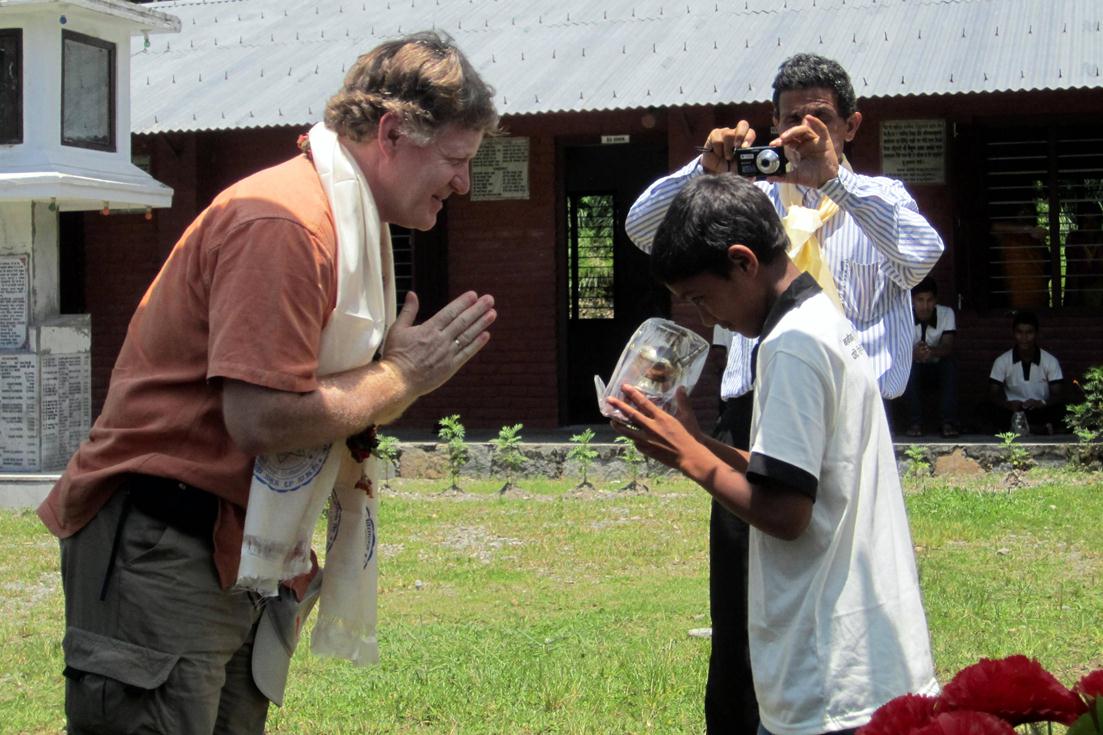
Arriving at our first stop, the local school, we apparently took the staff by surprise: we were too early for them, but they didn't tell us that, so instead we were taken on an impromptu ‘tour of the school’ which coincidentally ended with my colleague and I walking up the same drive way, only this time the welcoming committee was ready with the red powder for our forehead, the garlands, flowers and traditional scarf – and a corridor of children who had been called in from holidays to welcome these visitors from Australia. (They weren't too unhappy!)

Before the big event though we had to have lunch, at 10:30am, boiled rice, lentil water, potato/bitter gourd curry, and bamboo shoot pickles. Our hosts tell me that in Nepal, or maybe just this part,  people don’t have breakfast, just a cup of tea – sweet, buffalo milk tea – which we had enjoyed before the windy, bumpy white knuckle ride up the mountain and then lunch mid-morning, "tiffin" (snacks) in the early afternoon and dinner later at night.

We then settled in for the two hour presentation which included 6 traditional dances from school girls, 2 poems written by girls for the occasion, 10 speeches, 6 from local politicians and community leaders, 2 from the school leaders, 1 from the Chief Guest and 1 (impressively powerful and articulate) from the head girl. (I’m not sure what the boys in the school do!)

4 hours after arriving in the school we moved on – this time to a nearby village where the women have formed a farmers group. Here the women have turned their village around through agriculture and animal husbandry. Most of the houses in the village have 2 ‘tunnels’ (open sided greenhouses) growing tomato, beans, corn, chili and bitter gourd all overflowing with new growth. They have been taught to farm organically and the results (and the books prove it) are impressive. All the members have increased their family’s income from between 10 – 20 times. The impact: children have school books of their own, they are all dressed in uniform they have shoes and they have fresh vegetables to eat. Some of the older kids have moved on to university. The women are selling produce in market, they have a ‘pretty sari’ uniform for their group, they are sharing the produce with friends, and they have been invited to other communities to share how to grow their own food.

As we wait for the adults to organise their welcome, we have a game of soccer with an old, semi flat ball on the road. The boys are happy to do this! Especially when they manage to score against the white guy and his Ugandan mate.

By the time we are ready to head back down the Mountain after 7 hours, the cloud has burnt off and for the first time since I have been here the snow-capped Mt. Machhapuchhre (Fish Tail) has just pushed its way through the cloud in the distance. The road at least is all visible as we bounce back down to the city below.


Monday, 22 July 2013

Pokhara

Nepal’s second largest city (Pokhara) is situated on the shore of Pokhara Lake and in the shadows of the mighty Dhaulagiri, Annapurna and Manaslu Himalyan Range. At this time of year (monsoon) I have to take the word of the locals that the mountains exist because all I can see is the thick cloud banks that seem to both protect and threaten the city.

This city has also been the hub of the Kaski Area Development Program (ADPs). Since 2001 Australia has been supporting over 3,000 sponsor children and their families in 5 communities: partnering with local agencies and the people to improve the state of health for newborns and mothers, renew schools and education systems, introduce micro-finance cooperatives and increase income through livelihood opportunities and skill development for women and men.

As is standard practice these ADPs run for about 15 years, at which time, after extensive consultation with the families, the children, the communities and the local government we withdraw from the area. Each of these ADPs is designed to be sustainable - self-managing and self-perpetuating.

In the few days I have in the area, I have the privilege to attend two farewell celebrations: the first, today, was at a school about 30 minutes out of Pokhara. And here under a bunting enclosed canvas lean-to, I was entertained by young school girls singing and dancing – listened to the obligatory speeches – and then had the opportunity to present sponsor children with awards of recognition.

But it was here, and in a couple of other community meetings, (with the micro-finance cooperative, the women’s group and the Early Childhood Care and Development committee) that I heard about the impact of 15 years work by dedicated and passionate team members. Amongst these achievements are:
  • 80.4% of families have enough food
  • 98.1% of babies are breast fed
  • 85.3% of pregnant women attend medical checks
  • 98% school attendance
  • 98% proper waste disposal
  • 99.2% of families have a water sealed latrine
  • Government declared the district open defecation free (ODF) in 2011
I know you don’t know the previous statistics, but take it from me, these are significant improvements. But, the things that are most noticeable are the smiles, the laughter, the kids playing, clean and with a mischievous sparkle in their eyes.

Did everything work? No. Has every person involved had an improvement in their living? No. Are there things we can do better? Yes. But tonight, as the monsoon rains pelt down to the accompaniment of an amazing thunder and lightning show there are 5 communities in rural, isolated Nepal that are better off and there are at least 3,000 children that have dreams of being “engineers, doctors, teachers, bus drivers, paraglider pilots, and soldiers” – and they just might make it now.


Friday, 19 July 2013

Kathmandu, Nepal

"There are more mobile phones than toilets in Nepal" 
and so began my first meeting with the staff in Kathmandu this morning.

Flying into Kathmandu yesterday we had to break through a thick covering of grey, water soaked monsoon clouds but after the rough passage came the beautiful landscape of Nepal. Out the left of the plane, green rolling mountains dotted with houses and small flags; out to the right through the clouds, and at times above them, the Himalayas. Everything can look good from above!

The approach to the airport into the Kathmandu valley, (home to the three ancient Hindu Kingdoms, Kathmandu, Lalitpur and Bhaktapur), is narrow and surrounded by high densely multi-storey colourful housing. Nepal is no longer a Kingdom - following the Maoist wars - in 2008 it became a Democratic Republic, but still today there is no elected government. Surprisingly politicians can't agree on much - but hopefully in November this year the hundreds of political parties will come together in the first election.

Nepalese Flag
Nepal is a country of about 26 Million people, (1.2M in Kathmandu Valley) and innumerable temples. A deeply religious people: Hindu (81%), Buddhists (9%), Muslims (4%), Christians (1.5%), Animists and others. It is surrounded by India to the south, east and west and China to the North and is very heavily influenced by India.

Over the next two weeks I will be travelling south and west to the cities of Pokhara (Kaski) and Kailali visiting the people that are impacted by, and partnering in, our programming in these areas. We are trying to transform the lives of children and families in these areas through education/school programs, maternal and new born child health initiatives, livelihood, economic development and child protection projects. Nepal has a terribly high rate of child brides, (some as young as 9), of child labour and migration (to India for work). Through education programs and advocacy campaigns we are attempting to change these practices - and thankfully, we are able to report some successes.

It is a long process, but in some of these incredibly remote and hard to get to places we are making a difference in the lives of children and their families. But it is not always good news - just a few weeks ago a child in one of our communities died of malnutrition - this shouldn't be happening. Why, with all the resources we can make available are children dying from such a preventable issue?

As I walked around Thamel and Lalitpur this evening, I commented to my colleague that there were, for me, many similarities to Port-au-Prince (Haiti). Densely packed buildings with electrical wires hanging low across the streets, buildings crumbling and obviously 'under code' - all in a valley that 'is overdue for a major earthquake'. As if the country doesn't have enough to worry about, the Disaster Management Committee advises that an earthquake of 6.0+ would devastate the valley. Historically, they happen every 75-100 years - that's about now.

The challenges are huge here, the answers are not simple. But there is no doubt that this is one of the most 'in need' places I have visited.

Tuesday, 18 June 2013

What is God Doing in Sri Lanka?

I had the privilege of addressing my colleagues at work today, this is some of what I said:


"God helping me: I take my everyday, ordinary life — my sleeping, eating, going-to-work, and walking-around life — and I place it before God as an offering. [Because] embracing what God does for me is the best thing I can do for him. I refuse to become so well-adjusted to my culture that I fit into it without even thinking. Instead, I will fix my attention on God. [As a result of this relationship with God and my life experience] I have been changed from the inside out. [I try to] Recognize what God wants from me, and quickly respond to it. Unlike the culture around me, always dragging me down to its level of immaturity, God brings the best out of me, develops well-formed maturity in me.” (Romans 12:1-2)


Relationships have the potential to turn you inside out. (Just ask any love struck teenager!) But one of the most powerful change agents I know is the privilege of meeting people, looking into their eyes, hearing their story and offering them the dignity they deserve for that time I have with them. It’s those moments that change me from the inside out.
An old poem by Ann Flint says, “God has no hands but our hands to do his work today”, so when we ask, what is God doing in Sri Lanka, what we really need to ask is what are we doing? What am I doing?
There is a whole theological argument behind that statement, (not the agenda of this morning) but I believe that God created humanity in God’s own image and that “it was very good” and that any attempt by you or I to restore the dignity, the hope, the self-respect and self-reliance of individuals is the work of God. Any effort made to reconcile human beings to one another and to God is God’s work. So, what we do, “engaging people to eliminate poverty and its causes”, that is God’s work, that is what God is doing in Sri Lanka.
Over the past few years WVL has been working hard to gain entry to some of the Tea estates in the high country of Sri Lanka under the premise of partnering with them to supply clean water and improved sanitation facilities. And this has happened – today families have access to water in their homes, as a result:
·      (anecdotally) children are healthier,
·      School attendance rates have improved
·      Schools have water and latrines
·      women are able to get to work on time, therefore their wages are not docked and the family has more income,
·      families are taking more pride in their community, (gardens, etc…)
·      communities are saving money and managing the facilities by themselves
·      People are proud of themselves, they have dignity!
But water was the catalyst to a much deeper issue. For over a hundred years there have been three distinct factions: Tamil workers, Sinhala/Foreign Estate Management and Sinhala Government. Essentially the Tamil workers were non-residents, they belonged to the Estate. Government didn’t have jurisdiction, or concern. Management were masters of their own empires.
The project seeks to create new relationships between Management, Community and Government. Management has seen the benefit of supporting their workforce, listening to them and partnering with them for improved conditions, and links have been forged between Government and Management for improved infrastructure. Believe it or not, getting people talking together benefits everyone. Sinhala is talking with Tamil, Management is listening to Worker and Government is integrating Workers into country.
The project is designed as a Peace-building, Water and Sanitation project but it is, as all development projects should be, actually about reclaiming or restoring the dignity and self-worth of people that through no fault of their own, just because of the accident of birth place, are impoverished, marginalised and neglected. And it is successful because people have taken the time to build relationships of trust that are resulting in personal transformation.
But the transformation is not just on the part of the beneficiaries, the poor and the marginalised; transformation (or change from the inside out) is occurring in all the project actors.
You travel and listen to the project staff and you will hear and see passion and determination. These people have seen the difference bringing water to a house has made. They have seen the before and after. They have seen the ‘glint’ in the eye of a mother return when she realises that she doesn’t have to send her daughter to walk 4 kilometres for water any more. They have seen the school boy splashing his mates at the school bathroom. Changing (hardened, theoretical) development professionals from the inside out – that’s what God is doing in Sri Lanka.
You listen to the Estate Manager who proudly speaks of the fact that he has less ‘sick days’ to reschedule because people are not sick anymore. Of course he sees the benefit to his bottom line, but as he kneels to accept a flower from a little girl, he touches her shoulder and looks into her eyes – she smiles and they laugh together – that’s not fake. Creating a new heart that cares about more than the dollar – that’s what God is doing in Sri Lanka.
You sit in the boardroom of the local government office and you listen as they tell you all the wonderful things they are doing for the people – as if it was their idea – but you also hear about a new relationship that exists between the Management and Government. Power brokers are listening to one another and are working for a common good – for the rights of the poor and the marginalised. Reconciling relationships, creating partnerships of transformation that is what God is doing in Sri Lanka.
You hear the stories of the workers as you are proudly welcomed into their homes. They greet you at the threshold to their community with flowers, beetle leaves, and a cup of tea. Like a modern day pied piper you’re followed around the community: land that was swamp and putrid a year ago is now channelled and planted out with vegetables. 100 year old homes have been lime-washed bright colours. People speak of hope for a better future for their kids. Restoring dignity is what God is doing in Sri Lanka.
This is some of what God is doing in Sri Lanka. But all this starts, not in Sri Lanka but it starts in one person – one person who decides it’s worth caring. It starts with you! It starts with me! It starts because something, (or some One) has happened that changed and is changing you from the inside out and you have recognised what God wants from you. You may not call it that – you may not use religious or faith language – but that doesn’t change the fact that you are doing God work!
That is what I (and other program managers) do in our in-country work for World Vision and for God. We build and maintain relationships of trust that lay foundations for multilevel transformations: transformation of individuals and transformation of communities. It’s only through relationship and trust that we have a hope of changing the world.


May the Lord disturb you and trouble you,
May the Lord set an impossible task before you,
      And dare you to meet it.
May the Lord give you strength to do your best,
      And then - but only then -
May the Lord grant you peace.


Wednesday, 29 May 2013

He Knows My Name!

He stood before me, tall and proud. "He's a rugby player" they announced with obvious pride, "He plays for one of the best schools".

As I sat eating my breakfast the same waiter served me again, he has been on duty for the last few days, and like most of the staff they are efficient, friendly but quietly unobtrusive. But some people cannot be constrained!

The two of us have struck up a friendship - frowned upon I suspect by the boss at first, but when he realised it was a mutual friendship he joined in; and so I learned that Lakshantha is a rugby player. And it all started because I called him by name (thanks to his name tag).

I have been reminded on many occasions over these past few weeks how important it is to treat people with dignity - and to call them by name. It was as if I had done something remarkable when Lakshantha heard me say his name - as big and tough as he looks, his eyes lit up and he smiled and amazing, shy smile.

It was a vast difference to the complete disregard, disdain and downright rudeness with which I have seen some of the guests treat Lakshantha and the other staff. Sometimes it seems it is just too easy to treat people as if they are worthless or not enough - to put them down so that we can feel superior. To put them in their place so that we can feel in control and powerful. Maybe an easy way to do that is to refuse to acknowledge another's name.

But when we hear our name spoken by a person who is looking into our eyes, it is then that we know that we have been acknowledged, we have been called worthwhile, we are enough! I am so grateful to be reminded that God knows me by name - that the God who sees into my soul, my deepest, secret place - still chooses to call me by name and to call me 'very good'.

Lakshantha will be waiting for me in the morning, guarding the table that he has claimed as mine; we will talk about rugby, food and family - and he will let me into a little more of his world - not because I am anything special - but because I took time to see him, and to call him by name.

Thursday, 23 May 2013

Captain Crowden and Mrs Captain? I Remember Them!

I have spent this week facilitating a Project Design Workshop in the Jaffna Public Library. Together with the project staff we have been joined by members of all levels of local government and community members. It was during our first Tea break, after I had been introduced that an elderly man from the Pradeshiya Sabha (Local Government) approached me with great excitement: "Your name is Crowden", he said, "Captain Crowden and Mrs Captain, I remember them."

Apparently in 1974 Captain and Mrs Crowden had some dealings with the Remand Board, or something like that, and it was this man who now stood before me asking if I was related.

I am not sure if there are many people that have made such a lasting impact. Mum and Dad; the people who remember you in all kinds of places in this country and speak highly of your humility, your integrity, your availability and your friendship are innumerable. I have now been told how wonderful and loving you are in Colombo, Kandy, Batticaloa, Jaffna and Kaithady.

I wonder if you realise how many people are serving in Ministry, how many are Officers, how many have your picture (really old ones) on their walls and the positive impact you have had on the people of Sri Lanka. It was like walking into a living museum this evening when I visited Shalom Children's Home in Kaithady. I was met at the gate by Mrs. Rani Moses with the words, "welcome home son"; Major Thevasagayam was waiting at the Hostel and all around me it felt like nothing much had changed in the last 40 years. The property has big shady trees, and a couple of new buildings, but the chicken shed (collapsing) is still there and with great pride they took me into the kitchen to show me the 'pantry' that Captain had built.

Mum and Dad, your influence and your love have sustained many people (not just in Sri Lanka). You can be very proud of your ministry - I know I am!

Monday, 20 May 2013

The Cost

I awoke early on Saturday morning to the sound of an amplified voice, not all that unusual really for this part of the world, but this time it was a little different. It was 6:00am, and accompanying the voice were thousands of military personnel marching to the beat of half a dozen Military bands. They processed from the city end of Galle Face Green towards the iconic Galle Face Hotel before stopping in formation and at attention to listen to speeches from the officials.

It was already hot and humid and they marched in full regalia: there were snipers in ghillie suits, bands in pith helmets and feathers, bomb squad in full armour (even the black labrador had a cloak) - behind them, lining the full length of the sea wall all shapes, sizes and models of military vehicles gleamed in their new paint work. Proud soldiers wiped the dust and salt off their vehicles; a never ending and seemingly futile pursuit.

May 18 marks the 4th anniversary of the end of the war; some call it Victory Day or National Day others try to forget the day when hundreds of civilians died in Mullaitivu. But no matter what you call it, the last two groups bringing up the rear of the procession that salutes the President introduce a somber atmosphere to the celebration. A number of flat beds with amputee soldiers precede lines of wheel chair bound soldiers being pushed by comrades - all are dressed in beautiful, formal uniform, some try to hide amputated arms, others try hard to keep their heads high and proud. As they process down the road cameras are lowered and voices are hushed, no one wants to intrude on this moment - we are reminded of the cost.

Friday, 17 May 2013

Unidentified People

"We were unidentified people, you have identified us" 

In the High Country of Sri Lanka is the beautiful, mostly cool and green, district of Nuwera Eliya. This is most likely where your Ceylon Tea comes from, and for over 150 years has been the home to some of the world's best tea brands.

The picking and production of that tea relies heavily upon the Indian Tamil community that many years ago was brought across the ocean to labour on the estates.

The treatment of this group of people, who for many years did not belong either here in their homes, or in their place of birth, has not been something that we can be proud of. Even today some companies treat their labourers pretty much as slaves. But for some, and hopefully and increasing number life is changing.

In recent years they have been granted citizenship and their communities, often collections of run down 100+ year old buildings with no water or sanitation, have been recognised as 'villages' and subject to all the rights and responsibilities of all villages.

In one estate these people are now referred to as 'associates' and they have been given shares in the tea company. They have been received'official' identity cards from the Tea Company which they hang proudly around their necks - for the first time in over 150 years - these are an 'identified people'. As the President of the Community Based Organisation on the estate tells his story his voice rises with passion, he speaks faster and faster and I wonder if he will actually stop for a breath at all. When he finishes his community clap him - and they echo his words, spoken in Tamil, but translated as 'you have identified us!'

Today fresh water comes to their doorstep, and waste is channeled away appropriately. They list for me the results of this intervention:

  • I have clean water in my house and we have safe sanitation
  • I am able to save money because I am no longer having to pay hospital and medical bills every week for sick children
  • In the past the water was a little distance away but it took me about 4 hours a day to collect water because the line was long, and there was often conflict at the collection point: today, because the water is in my home, my children are at school early, I am in the field on time and we are not being docked money because of being late.
  • Now I am happy to live here
  • I and my family will always live here, this is our home - but I want my children to get good jobs, not plucking green leaf.

Those that have been here for the past years of this work describe the transformation as miraculous, not just in the infrastructure, but in the attitudes and satisfaction of the people. "Its all about the people", says the Manager, "if the people are well and happy they work, not because they have to, but because they want to. Of course there is an economic benefit for the company, but the most important thing is the people are true citizens and they are treated with dignity."

Wednesday, 15 May 2013

Colombo, Puttalam, to Batticaloa

It has been a crazy but good two days. I arrived in Colombo, late because of a fog clogged Dubai, and 10 minutes after checking in was out to dinner with the Hettiararchchi family - the frantic start seems to have set the pace for the trip so far.

Arriving in Nawagaththagame (near Puttalam) on Monday afternoon we were whisked off to meet with three Permaculture project beneficiary families, but in the Sri Lanka way, it was not just the families but their community. We were welcomed onto the property by a group of children bearing gifts of Betel leaves for each of us, and after receiving the leaves the children knelt at our feet and paid their respects to elders and visitors.

In this community and the two which would follow we were introduced to families who have been trained to design and plant organic gardens, take care of cows and chickens and in a few cases bees. It is humbling to hear the stories of children who no longer attend clinics for gastric issues on a very regular basis because now they eat fresh vegetables and fruit, and they drink clean, safe water and milk, and because of the extra income available from surplus produce  they go to school, in uniform, with books and shoes and they love it!

Mum's and young women are managing their own gardens and finances. Some have bought extra cows and chickens, others are learning the art of 'value add' by turning surplus milk into yogurt and milk toffee which they sell to local traders and share with community.

They have established seed banks which together with the 'cattle banks' (the second new born calf must be given away to another member of the cooperative), means that the community is benefiting from the success of our direct beneficiaries.

And all this is good, very good, but perhaps the most powerful results are those less tangible, but more life transforming impacts: a dad who for most of his life has worked away from home now works at home 4 out of 7 days and is making enough income to begin to build a new brick house for his family - "I can watch my children grow now and I can afford to keep them healthy and in school, they have a chance now". His wife, who was trained in organic pesticide production is the village leader in plant nursery production, she teaches others how to do it, and from her own stock is helping other families establish gardens. She is a voluntary permaculture teacher - and as she talks about her work her eyes are smiling, her little 8 month old baby is obviously healthy - she is happy.

In many ways a simple intervention, but one that has produced hope, trust, community, happiness as well as food, milk, honey and income for over 4,000 families - so now phase 2 commences with another 3,800 families, in 5 new communities.

Thursday, 9 May 2013

On the way back to Sri Lanka

On Saturday night I head back to Sri Lanka for three weeks working with the World Vision Lanka team.

Over the first week I will facilitate and accompany three AusAID officers who are coming to check out the work being conducted by our team with Australian Aid money. And have we got a week planned for them!

First we will head up the west coast to Puttalam district where they will meet families who as a result of a permaculture program are now growing enough produce on their own land to feed their children and pay for their schooling - and still have excess to sell, or barter. Having food and water for your family is a basic right often taken for granted, but being able to do it yourself, to be in control and to have choices - well that's living!

In the middle of the country is the beautiful hill capital of Nuwera Eliya, an oasis from the heat and humidity of the lowlands. This is tea country - if you drink Ceylon tea there is a good chance it comes from this area. But not all is green and fragrant - some of the plantations do not take good care of their, primarily Tamil, workforce. Many of these communities have no safe, clean water on tap, many have no adequate sanitation and as a result there is a high prevalence of illness. It's here that Australian money has been working to rehabilitate water sources and provide basic sanitation - but it's not just about providing services. This has been a catalyst to get government talking to estate owners and community members, and estate owners taking ownership for the conditions in which their workers live. New partnerships have been created, people are talking to each other, Tamil workers are talking to Sinhalese owners and governments - tea production is up, sickness is down - but again it's the peace building and self-determination that has transformed communities and individuals.

Across on the East coast, in an area devastated by extended war and a tsunami, Australian's have sponsored about 3,000 children and as result of that money a maternal, new-born child health program has begun to turn the devastation of malnourishment in the most vulnerable babies and train mothers how to sustain that health; pre-schoolers have gone back to school, teachers have been supported and trained; and home gardens are being established which will mean that families can support themselves and maybe generate some income.

And then, in the second and third week, the fun starts... I travel to the Northern city of Jaffna where I have the privilege of facilitating a design workshop for a new $3 Million Water, Sanitation and Hygiene (WASH) project in two communities. Another Australian Aid funded project, we will work, through local partners, to increase the adoption of improved hygiene practices and sustained equitable use of water and sanitation facilities. (More about that in the future...)

But of course, as well as working, I will pay an obligatory visit to Barefoot and Odel and I will catch up with Salvo family and friends, looking forward to that too :)