I get all the good jobs!
Negotiating allowances and position descriptions after people have been working for a few months is more akin to dentistry than HR! I have spent the afternoon making sure everyone knows what is expected of them and, of course, how much money they can have for it. That's the bit that we always seem to get stuck on, and it is due in part to the knowledge that the BIG INGOs pay BIG bucks, and in some cases way above the national average.
People know there is "plenty of money" (how often did I hear that today?) and it doesn't take some of them long to want their share of it. But there is a balancing game to be played: that is paying a person their worth, in the context of a country like Haiti, paying them what we can sustain and what we can afford within the limits of being accountable to donors who give their money to make a difference in the lives of the Haitians.
Then you have the person that argues with you about the amount because he wants to make sure that the programs and the survivors are getting enough. Despite the fact that he lost his wife and house in the earthquake, and has four kids to support he says, "but Sir, you have come to help Haitians, you have come here for us, I should not take this (pay envelope) from you I should be thanking you for letting me help you help my people".
So tonight I am all negotiated out and to make matters worse I think our cook/housekeeper hates me now :(

Thursday, 5 August 2010
Wednesday, 4 August 2010
PROGRESS UPDATE
 The first container was released today! (To all those that went before, Jean Robert, pulled it off and we should have 4 containers unloaded by the weekend - without a Franchise Certificate.)
But before I go there let me say that I had the privelege of seeing some beautiful unspoilt forest today. I travelled along the coast to the city of Petit Goave. Like all the urban areas I have been in so far it is a place filled with detroyed buildings, rubble and shelters of all sizes and materials. Situated on the coast it is a nice place. But to get there I had to pass over a mountain that cut through a fairly unspoilt forest area, with cocounut and fruit trees framing the relatively wide, smooth road (of which there are very few in Haiti).
The Salvation Army complex is quite large with a church (Corps), school and offices - but as of Monday it will also be home to a new Clinic. Finally, the project has been approved, the reporting structure has been designed, and the money has been delivered (today). Soon more people will be able to access medical care. This is another good initiative and a win.
The Salvation Army complex is quite large with a church (Corps), school and offices - but as of Monday it will also be home to a new Clinic. Finally, the project has been approved, the reporting structure has been designed, and the money has been delivered (today). Soon more people will be able to access medical care. This is another good initiative and a win.
And then to add to that we have had a number of containers of relief g oods, including camp cots earmarked for the IDP Camp held in customs for a number of months now - but today the first one was released and arrived at our warehouse. So tonight the first 2,500 cots have been unloaded and are ready for distribution. As soon as the rest arrive, (hopefully tomorrow) we wil begin the process of distirbuting these to the families in our camp. This means liaising with the UN Forces to provide security, and splitting the people into probably two groups to do the distribution over two days.
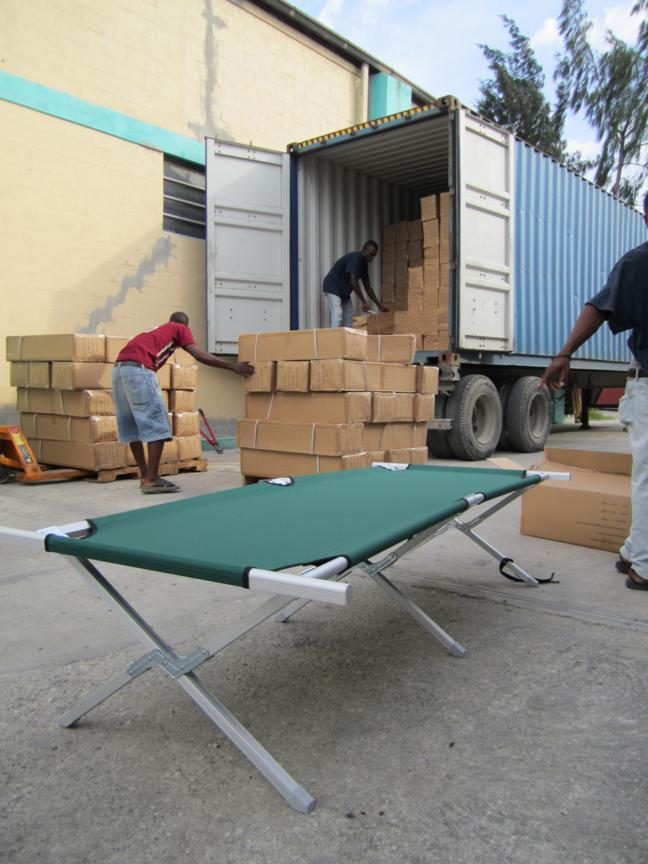 oods, including camp cots earmarked for the IDP Camp held in customs for a number of months now - but today the first one was released and arrived at our warehouse. So tonight the first 2,500 cots have been unloaded and are ready for distribution. As soon as the rest arrive, (hopefully tomorrow) we wil begin the process of distirbuting these to the families in our camp. This means liaising with the UN Forces to provide security, and splitting the people into probably two groups to do the distribution over two days.
If it is anything like today (40C, 88% humidity) it is going to be warm work. But at last some of the promised can be fulfilled!

Tuesday, 3 August 2010
HOW TO FACE WITH DEATH
Today's blog is shared with the permission of The Salvation Army - Haiti's Assistant Camp Manager: Rodney Belain. It is a piece he wrote after a particularly rough day.
 Life is something that you cannot understand and you can even spend all your time, you will never understand it. There is something that says death is easy but life is hard. All you have to do is to live your life as it comes and do not let anything to bother you, you’ll find a lot of people who will bother you but, don’t let them do it.
It’s only one thing that I would like to ask you, give Jesus your life, let him guide you, let him teach you how to live and how to help the others. I know that no one is perfect, but a part of you is. Even if you don’t see it in you, sometimes you want to do stupid things, fight yourself and try not to do it. As you know God can make a way where there seems to be no way he works in ways we cannot see. I will follow him ‘till death, cause he is the almighty God.
I suggest you pray before sleeping, talk to God let him know what you think, ‘cause he’s your best friend you ever have. And he will bless you all the time.
For you my friend, think about that brothers…
--------
 Life is something that you cannot understand and you can even spend all your time, you will never understand it. There is something that says death is easy but life is hard. All you have to do is to live your life as it comes and do not let anything to bother you, you’ll find a lot of people who will bother you but, don’t let them do it.
You need someone to comfort you when you do not feel good, I mean miserable, I just want you to know that God is there for you, bring him all your burdens, cause he cares for you.
Sometimes, I ask myself why God has created us, because some people need help and some spend a lot of money without thinking about the others.It’s only one thing that I would like to ask you, give Jesus your life, let him guide you, let him teach you how to live and how to help the others. I know that no one is perfect, but a part of you is. Even if you don’t see it in you, sometimes you want to do stupid things, fight yourself and try not to do it. As you know God can make a way where there seems to be no way he works in ways we cannot see. I will follow him ‘till death, cause he is the almighty God.
I suggest you pray before sleeping, talk to God let him know what you think, ‘cause he’s your best friend you ever have. And he will bless you all the time.
For you my friend, think about that brothers…
Sunday, 1 August 2010
THE ROAD TO JACMEL
 As the car laboured up the steep slope all you could see was where the track seamlessly joined the sky, you knew there had to be more track at the top but it still came as a surprise when we reached the apex and there it was stretching out before us. Like a monsoon rain burst on a scorching Haitian afternoon it was a relief – we were on flat track, and we could see the track ahead - it appeared to stay flat for a while before the hairpin bend to the right and more flat and straight before it dropped off at an alarming gradient.
We motored along on the flat and straight, watching the scenery go by for as far as the eye could see, the hairpin bend arrived and the front of the car seemed to disappear over the edge before you were suddenly whipped around to the right and stabilized for a few seconds before plunging down the next valley. Mad Mouse had done its thing again. Kids screamed as the cars flew around the track and as they were flung first left and then right, for a momentary illegal touch (and shy knowing smile) against the girl they liked but couldn’t say. For the 60 or so seconds the ride at the Melbourne Show took it was at once exhilarating and down-right scary. But when it was all over the destination was wonderful – you had conquered the ride.
Yesterday, I took Haiti’s answer to Mad Mouse from Port-au-Prince to Jacmel, a place famous for Pirates (I reckon saw a painting of Captain Jack Sparrow on the dock) and now almost 600 Salvation Army (SAWSO) Temporary Shelters.
 We came over some beautiful green covered mountain scenery that dropped away to the beautiful azure coloured ocean on both sides. We hung on with white knuckles as we were thrown from one side of the car to the other. As we swung wildly from side to side - dodging tap taps, motorbikes, people, potholes, and disappearing roads created by the earthquake - we were assured that our driver was very good.
I watched fascinated though, (trying to think of something else other than the 2,000’ drop) as four beautiful large hawks slowly rose on invisible mountain thermals alongside the road, they seemed to keep pace with us without moving a muscle, their wings locked in and their heads pointed towards the ocean. As they rose and fell with apparent ease alongside us I was reminded that I can be like the thermals, I can be part of that which lifts people up, which sets them above their circumstances. I have an amazing privilege.
Saturday, 31 July 2010
JUST WHERE HE (GOD) NEEDS ME
24 years ago I stood before my session at The Salvation Army's Officer Training College in Melbourne and sang "Just where he needs me, My Lord has placed me, Just where he needs me there will I be..."
I'm not sure that I really understood what I was saying! Nor did I ever imagine that my promise would take me to the places and require me to make the choices I have. You see I believe passionately and completely that God has - through my life experiences, through the models of my parents, through the studies that I have completed and through confirmation of my wife and daughter - asked me to be available; to go and to leave!
Let me be honest: I love travelling, I love flying, I love immersing myself in other cultures, I love being able to help others, I love being part of a life-transforming experience in a persons life. But I really don't like being away from Sandy and Alexis as long as I am at times.
But you know what: I will continue to make the decision to go as long as I can and when/if I am asked because WE believe that this is exactly where and what God made US to do. It is not a choice we make because we're trying to get away from one each other, or trying to frustrate our leaders, it is a choice we make because we know (through accident of birth and no merit of our own) that we are so privileged and have so much.
Emergency Services work is, for me, simultaneously the most amazing privilege and the most painful decision. God, just where you need me, there will I be.
I'm not sure that I really understood what I was saying! Nor did I ever imagine that my promise would take me to the places and require me to make the choices I have. You see I believe passionately and completely that God has - through my life experiences, through the models of my parents, through the studies that I have completed and through confirmation of my wife and daughter - asked me to be available; to go and to leave!
Let me be honest: I love travelling, I love flying, I love immersing myself in other cultures, I love being able to help others, I love being part of a life-transforming experience in a persons life. But I really don't like being away from Sandy and Alexis as long as I am at times.
But you know what: I will continue to make the decision to go as long as I can and when/if I am asked because WE believe that this is exactly where and what God made US to do. It is not a choice we make because we're trying to get away from one each other, or trying to frustrate our leaders, it is a choice we make because we know (through accident of birth and no merit of our own) that we are so privileged and have so much.
Emergency Services work is, for me, simultaneously the most amazing privilege and the most painful decision. God, just where you need me, there will I be.
Friday, 30 July 2010
FRUSTRATIONS
 So this week again our Camp Manager and her team were reminded that the heroes can quickly become the enemy. It's a natural part of the cycle of disaster recovery and one that is not limited by culture, language or cause of emergency.
In Sri Lanka following the Tsunami (2004) we saw this reversal of fortunes after about 4 weeks. In Whittlesea (Australia) after the Black Saturday bushfires (2009) we saw it begin a little earlier, after about 2 weeks. Here, in Place de la Paix, Haiti (the IDP camp comprising about 20,000 people that The Salvation Army manages) the tide of emotions manifest through blame and anger, celebration and joy has ebbed and flowed over the life of the camp. But this week it got nasty again and took a few by surprise.
It often starts because survivors know, or believe, that there are resources available, but they remain hungry, cold, wet or sick. They hear that the material they need is on the dock, but isn't being released. They see reports claiming that the government has the promise of millions of dollars (and euros etc) but it isn't coming. And the only people that they can see, the only people that they can get to are the rescuers - the only people that continue to be present with them are the relief agents - they have been there from the beginning. So who else can a survivor vent their frustrations on, who else will listen - the people that make the big decisions aren't around, and seem to be deaf and blind to the reality.
So when the frustrations, anger and yelling comes, and it will, remember that's what you signed up for (that's why you get the emblazoned vest with all the pockets). It's hard not to take it personally, but you know what: it's not about you. You have to cop it, you have to manage it, but remember why you're here and like someone else said "do it for the least, the hungry, the tired, the cold, the naked, and after they've yelled, do it again" (my paraphrase) and by these acts they will know who represent.
Wednesday, 28 July 2010
LET THEM EAT SOUP
 On January 1, 1804, Haiti (Haitian Creole: Ajiti, land of high mountains) proclaimed its independence and became the second independent state in the Western Hemisphere and the first free black republic in the world. This unprecedented victory over a colonial power symbolised the aspirations of enslaved and exploited peoples around the world.
 Today (206 years after independence) outside the now destroyed Presidential Palace in Port-au-Prince you will see (an unscathed by earthquake) statue that symbolizes this struggle for freedom. Called “Neg Maron” (Brown Man) it depicts a slave blowing a conch shell while holding a machete in his other hand with a broken chain and handcuff. The conch shell was used to call escaped slaves to gather; the machete was used to cut sugar cane and to fight off the French; and the broken chain symbolises slaves breaking from bondage and reclaiming their freedom.
[By the way: When the French ruled, they established a law stipulating that only they, the ruling class, the rich and free, could eat soup. Their New Year's Day tradition was to eat soup. But when Haiti proclaimed its independence, all Haitians - slaves and generals, land owners and cane cutters – all ate soup. It was their way of demonstrating that everyone was equal and the tradition has been adopted – now Haitians eat soup on Independence Day!]
Neg Maron has become one of the ubiquitous symbols of Haiti. At just about any, and every, souvenir stall in the city you’ll find wooden, stone; large and small representations of Neg Maron.

I wonder if anyone has contemplated the paradox of symbolism that exists today. Looming huge in the background the now imploded and inevitably demolished (White House) Presidential Palace. One of the country’s most powerful symbols of authority, its sterile whiteness and imagined luxury protected from the commoners by fences and guns. The seat of power and some would say the blockade of progress. In the foreground, casting a shadow on the manicured lawns of the broken Palace, Neg Maron, historical symbol of freedom, equality and enterprise; image of celebration and new opportunity stands unprotected and disaffected by the forces of nature. I wonder if you can imagine the disdain with which he faces another attack, and stands! Which symbol will dominate, or perhaps inform Haiti’s future?
Monday, 26 July 2010
WHERE AM I?
Have you ever asked that question?
I remember as a little boy, (for those rude enough to think it, yes even shorter than I am now) our family went camping. My brother and I went exploring alone, and we got lost. I remember being frightened and I remember my big brother yelling out for Mum and Dad, only to discover that we were actually only about 50 meteres away, we just couldn't see them!
 Anyway, wouldn't it have been great if we had GPS technology back then? Well we do now, so if you have Google Earth you can check out where I live, where I work, and some of the places I visit. (Just be careful when you plug in the coordinates if you're in Australia, it is quite a dizzying ride from Australia around the globe to Haiti.
I remember as a little boy, (for those rude enough to think it, yes even shorter than I am now) our family went camping. My brother and I went exploring alone, and we got lost. I remember being frightened and I remember my big brother yelling out for Mum and Dad, only to discover that we were actually only about 50 meteres away, we just couldn't see them!
 Anyway, wouldn't it have been great if we had GPS technology back then? Well we do now, so if you have Google Earth you can check out where I live, where I work, and some of the places I visit. (Just be careful when you plug in the coordinates if you're in Australia, it is quite a dizzying ride from Australia around the globe to Haiti.
- Home/Office: 18°35'22.95"N / 72°14'23.00"W
- DHQ (New Site due to earthquake damage of old buildings): 18°33'26.69"N / 72°19'37.93"W
- Place de la Paix (Salvo run IDP Camp): 18°33'25.04"N / 72°20'15.20"W
- Children's Home: 18°33'24.13"N / 72°20'12.58"W
- School: 18°33'21.69"N / 72°20'11.94"W
- (Old) DHQ (Back) & Clinic Front: 18°33'23.93"N / 72°20'9.84"W
- Port-au-Prince Corps: 18°33'23.18"N / 72°20'11.08"W
Just note that the images (I get) are dated 25 January 2010, (13 days after the quake) so it looks like the IDP camp is half full, let me assure you that it is now completely full and overflowing. (In the 'Fly to' box type in coordinates in the following format: 18.332318, -72.201108, you should be near Port-au-Prince, if not navigate using the coordinates that appear at the bottom of the screen.)
Sunday, 25 July 2010
JAN 12TH EARTHQUAKE KEY FACTS AND FIGURES
 Almost 3.5 million people experienced strong-to-extreme shaking in the January 12 earthquake, including the entire population of Port-au-Prince (2.8 million, equivalent to the City of Chicago, or Madrid (2.8) or Taipei (2.6)). Source: Office of the Special Envoy
 The Haitian Government estimates that 222,570 people have died and 300,572 have been injured, but the true death toll will never be known. Source: DPC, referenced in OCHA Situation Report #25, March 2010; Haitian Government referenced in the Flash Appeal
1.5 million children and young people under 18 were directly or indirectly affected by the quake – approximately 720,000 are aged between 6 and 12. Source: Education Cluster referenced in the CAP
Displacement
At the peak of displacement, around 2.3 million people left their homes including 302,000 children. Source: Department Protection Civile referenced in the CAP; Education Cluster referenced in the CAP
1.5 million people are living in spontaneous settlements across the affected area including an estimated 309,000 children. Source: IOM; Education Cluster in the CAP
At their peak, over 1300 spontaneous settlements were identified by the Camp Coordination and Camp Management cluster. Source: DTM May 2010
After the earthquake, 604,215 people left Port-au-Prince and the West Department. An estimated 160,000 persons moved from Port-au-Prince to the border area with the Dominican Republic. Source: OCHA Situation report #25, March 2010
Destruction
188,383 houses collapsed or were badly damaged and 105,000 were completely destroyed. Key buildings destroyed including the Presidential Palace, the Parliament, the Cathedral and the majority of government buildings – in total 60 percent of government, administrative and economic infrastructure was destroyed. Source: PDNA and the Government of Haiti
4,992 schools were affected by the earthquake – 23% of all schools in Haiti. Of these, 3,978 were either damaged or destroyed – 80% of the affected schools. These schools closed after the quake. Source: Ministry of Education assessment referenced in the CAP
80 percent of schools in Port-au-Prince and 60 percent of the schools in the South and West departments have been destroyed or damaged. Source: UNICEF
Eight hospitals were totally destroyed and 22 seriously damaged, more than half of the 49 hospitals in the three regions affected by the earthquake. The Health cluster recommends that all 30 be rebuilt. Source: Health Cluster referenced in the CAP
The total value of damage and losses caused by the January 12 earthquake is estimated at US$7.8 billion (US$4.3 billion represents physical damage and US$3.5 billion are economic losses). The damage and losses are equivalent of about more than 120 percent of the 2009 gross domestic product (GDP). This represents the highest economic impact of a disaster compared to national income in 35 years. Source: PDNA
750,000 women and girls of childbearing age were affected by the earthquake. Of these, approximately 63,000 are pregnant, and approximately 7,000 babies have been delivered every month since earthquake. Source: UNFPA
The earthquake reduced Haiti’s gross domestic product by 70 percent. Source: Office of the Special Envoy
At their peak, over 1300 spontaneous settlements were identified by the Camp Coordination and Camp Management cluster. Source: DTM May 2010
After the earthquake, 604,215 people left Port-au-Prince and the West Department. An estimated 160,000 persons moved from Port-au-Prince to the border area with the Dominican Republic. Source: OCHA Situation report #25, March 2010
Destruction
188,383 houses collapsed or were badly damaged and 105,000 were completely destroyed. Key buildings destroyed including the Presidential Palace, the Parliament, the Cathedral and the majority of government buildings – in total 60 percent of government, administrative and economic infrastructure was destroyed. Source: PDNA and the Government of Haiti
4,992 schools were affected by the earthquake – 23% of all schools in Haiti. Of these, 3,978 were either damaged or destroyed – 80% of the affected schools. These schools closed after the quake. Source: Ministry of Education assessment referenced in the CAP
80 percent of schools in Port-au-Prince and 60 percent of the schools in the South and West departments have been destroyed or damaged. Source: UNICEF
Eight hospitals were totally destroyed and 22 seriously damaged, more than half of the 49 hospitals in the three regions affected by the earthquake. The Health cluster recommends that all 30 be rebuilt. Source: Health Cluster referenced in the CAP
The total value of damage and losses caused by the January 12 earthquake is estimated at US$7.8 billion (US$4.3 billion represents physical damage and US$3.5 billion are economic losses). The damage and losses are equivalent of about more than 120 percent of the 2009 gross domestic product (GDP). This represents the highest economic impact of a disaster compared to national income in 35 years. Source: PDNA
750,000 women and girls of childbearing age were affected by the earthquake. Of these, approximately 63,000 are pregnant, and approximately 7,000 babies have been delivered every month since earthquake. Source: UNFPA
The earthquake reduced Haiti’s gross domestic product by 70 percent. Source: Office of the Special Envoy
Saturday, 24 July 2010
HAITI BEFORE JAN 12TH
 Many Haitians, when they speak of the earthquake, refer only to “before” – before, in 35 seconds, they lost so much: friends, family, homes, schools, churches – and their visions of the future.
What happened here on January 12th was a disaster of a magnitude that would have set any country reeling. Over 222,570 people have died, 300,572 injured and a staggering 2.3 million – nearly one quarter of the population – displaced. Despite these very difficult and painful circumstances, the humanitarian response was one of the largest of its kind ever mounted and continues every day to help survivors of this tragedy. It is the largest urban natural catastrophe in recorded history, and it devastated a country already deep in humanitarian crisis.
In 2009:
- 58 percent of children were under-nourished.
- 58 percent of the population lacked access to clean water.
- 55 percent of Haitians lived on less than $1.25 per day.
- Per capita annual income was $660.00
- Earthquake followed devastating hurricanes in 2008, which affected 800,000 people.
- Deforestation had left the nation with less than two percent forest cover. Source: Office of the Special envoy
- On UNDP’s Human Development Index 2009, Haiti came 149 out of 182 countries, the lowest in the whole of the Americas
- Probability of not living to 40 was 18.5% - higher than Eritrea
- Life expectancy 61 years – worse than in Myanmar
Source: UNDP HDR 2009
- 40% of households did not have reliable access to adequate food
- More than half a million children between the ages of 6 and 12 did not attend school
- 38% of the population over 15 was completely illiterate
- In 2001, 56% of Haitians were living below the $1-a-day line. Source: PDNA March 2010
- Unemployment in Haiti was up to 80%. Source: Protection Cluster referenced in the CAP
- Up to 173,000 children regularly exploited as domestic workers
- 50,000 children separated from their families in institutions
- At least 2,000 trafficked annually through and to the Dominican Republic
Source: Child Protection Cluster referenced in the CAP
- 50-55% of children were not enrolled in school
Source: Education Cluster referenced in the CAP
Infrastructure
- Only 3,400 kilometres of road, of which only 800 km was paved
- Only 12.5% of the population had access to electricity Source: Ministry of Works, Haiti 2006 – NB this goes up to 45% in Port au Prince
Agriculture
- 60% of the active working population lives in rural areas and depends on agriculture.
Source: PDNA - Haiti was still recovering from the hurricanes of 2008 which devastated 70% of the agricultural sector. Source: CAP
Health and Nutrition
- 44% of seriously ill or wounded people were unable to access health services prior to the earthquake due to lack of money for fees. Source: CAP
- Acute malnutrition was 4.5% in 2008-9 – including 15,967 children and 1,549 babies under six months
- Up to 60% of children and 46% of women suffered some kind of anemia
Source: Health and Nutrition Clusters, CAP
Friday, 23 July 2010
SOME GOOD NEWS?
The Haitian Government, and hopefully the people of Haiti, have recieved some good news, even if it is beyond the horizon of caring for the majority who are living under canvas or tin in crowded IDP camps.
On a day when the Transport Union called for a day of stop-work and protest against what it labels "a corrupt government", the International Monetary Fund (IMF) member countries voted to cancel the $268 million debt owed to the IMF and approved a new loan worth $60 million to boost the international reserves. This new three-year loan carries a zero interest rate until the end of 2011 and then, they say, the rate will remain 'low'.
The protests can turn violent and in fact did back in May when students were tear gassed by UN troops to return order. Many residents of Port-au-Prince stocked up on fuel and food in case the worst happened.
I'm glad to say that we have been holed up in our new compound and we have heard and seen no problems and in fact have been told that "nothing happened". The team has spent the day re-organising our world and getting down to some of the administration side of emergency response. After all we need to know what money we have, or don't have, and where it is going.
On a day when the Transport Union called for a day of stop-work and protest against what it labels "a corrupt government", the International Monetary Fund (IMF) member countries voted to cancel the $268 million debt owed to the IMF and approved a new loan worth $60 million to boost the international reserves. This new three-year loan carries a zero interest rate until the end of 2011 and then, they say, the rate will remain 'low'.
The protests can turn violent and in fact did back in May when students were tear gassed by UN troops to return order. Many residents of Port-au-Prince stocked up on fuel and food in case the worst happened.
I'm glad to say that we have been holed up in our new compound and we have heard and seen no problems and in fact have been told that "nothing happened". The team has spent the day re-organising our world and getting down to some of the administration side of emergency response. After all we need to know what money we have, or don't have, and where it is going.
Thursday, 22 July 2010
TEAM HOUSE
Today was "D" Day for IES Haiti. The old has gone, the new has come!
After much energy expended by previous team members we moved our accomodations from the Coconut Villa Hotel and our office from DHQ today and we are now located at #9 Rue Laraunt, Santos 23, Port au Prince. It's a bit of a drive into town, (about 40 minutes - give or take) but this is 'ours' for now!
It is a 'never been lived in' two storey house, actually two identical flats. The bottom floor will be the office and will also have two guest rooms, the top floor is our living quartes; three bedrooms, two bathrooms, kitchen and a lounge. Thanks to Vicki Poff we even have beds and some other 'luxuries'. The mains electricity is on its way, so at the moment we operate on generators and inverters, the internet too is on the way, so at the moment, thanks to Bob Poff, we are on borrowed internet time.
Tonight, I am sitting on the verandah, looking out over a ten foot high concrete wall topped with razor wire, but beyond that, and beyond the row of half built houses, I see a wall of green trees that attempt to hide the cloud covered mountain range in the distance. The rain is pouring down, a slight breeze is moving through the house and, if it wasn't for the generator, it would be nice and quiet.
After much energy expended by previous team members we moved our accomodations from the Coconut Villa Hotel and our office from DHQ today and we are now located at #9 Rue Laraunt, Santos 23, Port au Prince. It's a bit of a drive into town, (about 40 minutes - give or take) but this is 'ours' for now!
It is a 'never been lived in' two storey house, actually two identical flats. The bottom floor will be the office and will also have two guest rooms, the top floor is our living quartes; three bedrooms, two bathrooms, kitchen and a lounge. Thanks to Vicki Poff we even have beds and some other 'luxuries'. The mains electricity is on its way, so at the moment we operate on generators and inverters, the internet too is on the way, so at the moment, thanks to Bob Poff, we are on borrowed internet time.
Tonight, I am sitting on the verandah, looking out over a ten foot high concrete wall topped with razor wire, but beyond that, and beyond the row of half built houses, I see a wall of green trees that attempt to hide the cloud covered mountain range in the distance. The rain is pouring down, a slight breeze is moving through the house and, if it wasn't for the generator, it would be nice and quiet.
Subscribe to:
Posts (Atom)