Sunday, 9 September 2018

I’m Not Ok (Ambae Volcano, Vanuatu)

It may only be a small Island, but when the volcano on Ambae Island (Vanuatu) erupted, again, thick ash spewed into the sky cloaking the island and its inhabitants in deep ash falls.

For the second time in a few months, 11,000 people, the island’s entire population, was instructed to evacuate. It doesn’t sound like many people, does it? But when you consider that is 5% of the entire population of Vanuatu – that is a lot of people for already resource stretched and small communities to host. (5% of Australia would be about 1.3M people – imagine that news headline!)

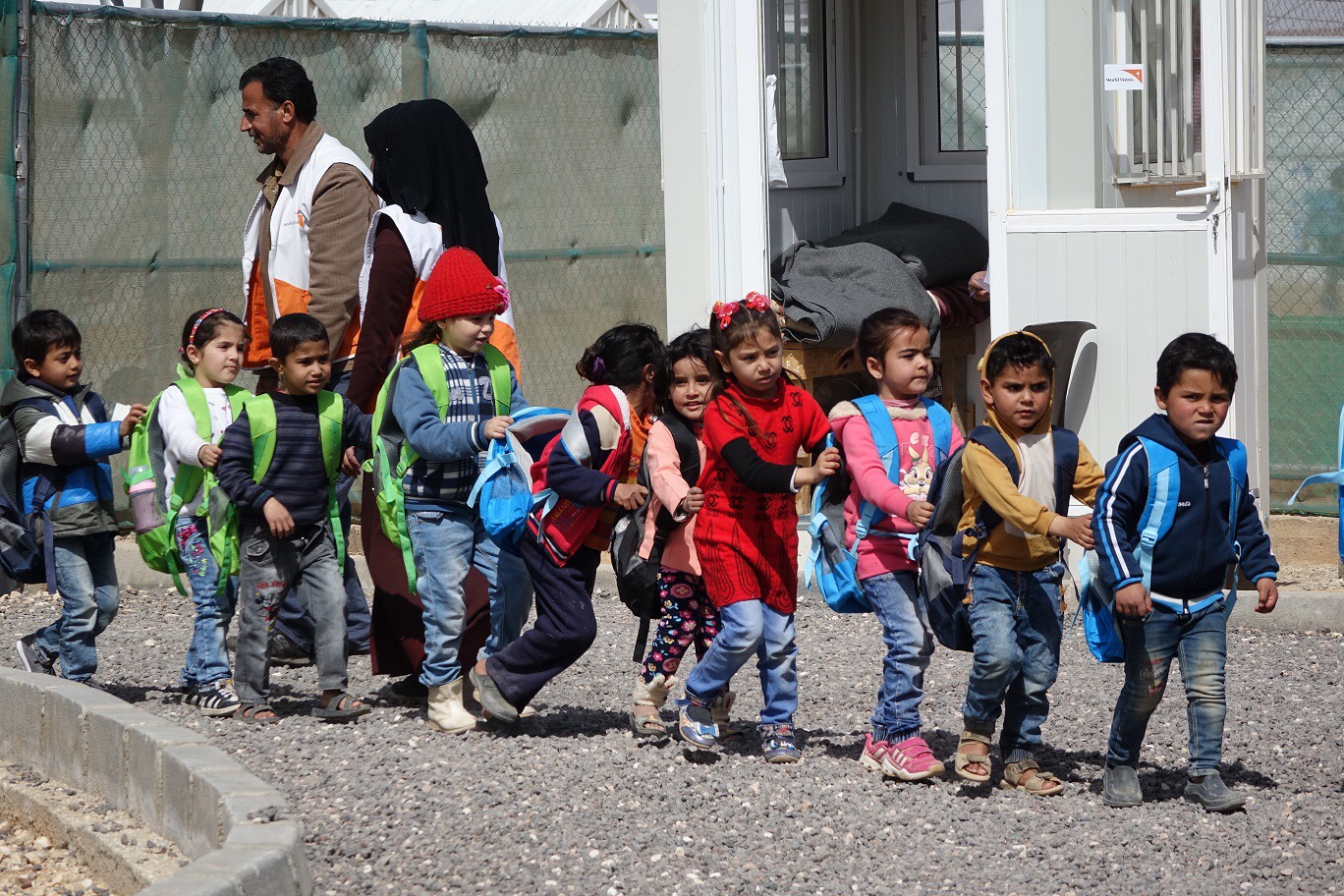
Ordered to evacuate to nearby Maewo Island with a population of about 4,000 people, was it any surprise that the host community could not cope and that most people chose to self-evacuate to the bigger island of Espiritu Santo?

The scent of the flowering mango tree is heavy in the warm air as we sit in the shade surrounded by some of the 125 residents of the evacuation centre just outside Luganville (Santo). This is some of the one community from North Ambae, the worst impacted area, and they have been here in the church yard, under canvas, for a little over two months now. Some of their family and community went to Maewo and others are spread throughout host families and centres around Santo.

As they share their stories we hear the grief of leaving everything they own; homes, animals, gardens and belongings and not knowing when, or if, they will ever get back. Scattered around the compound under the shade of trees are an odd assortment of tents and shelters made from all kinds of materials that have been bought, given and scrounged. A young girl stokes the fire under a pot of rice as she fights back the tears as the smoke wafts into her face and filters the sunlight.

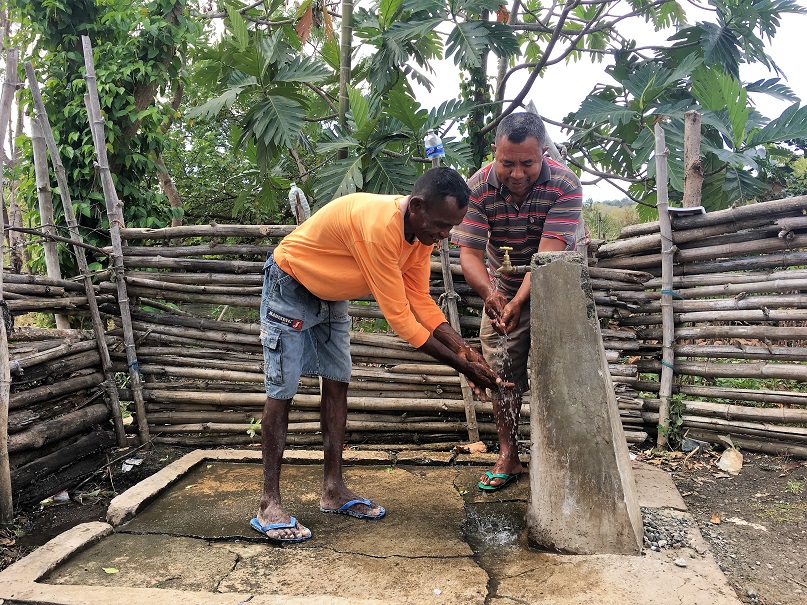
One of the most urgent needs in this evacuation centre, and across the entire evacuated population, is safe reliable water and sanitation. Some are having water trucked in and stored, but that is expensive and unsustainable, others are transporting water in twenty litre jerry cans from community wells distant from their location – but very few have water, or enough water, at the door or in the compound. Even fewer have safe, dignified sanitation options.

In the face of the difficulties and the stories of uncertainty, as I have seen so often in similar contexts, there are gems of creativity and innovation, hints of resilience and hope despite the hardship and the circumstances. I saw this here, again: one man has laid a new tarpaulin across the roof of his tent and formed a small reservoir at the base to collect rain water.

The Chief speaks with passion as he tells the story of their evacuation and their re-settlement here. But, then there is a moment of raw emotion that threatens to overwhelm us when he tell us of the previous groups that have been to hear their story and offer help: “People ask me if I’m alright,” he says, “I say yes. But on the inside,” he puts his hands over his heart, “I’m not ok! On the inside,” his hand points to his head “I’m not good!”

For a second I wonder why he tells people he is ok when he clearly isn’t – but I suspect I know the answer. Perhaps he feels, or knows, that many don’t really want to know the truth – after all what would they do with that?

With around an extra 7,000 people now in and around Luganville the population has grown by 30%. The Ni-Vanuatu generosity and graciousness has been overwhelming as many locals open their homes and yards to the evacuees. As a result, the world will not see horrific images of overwhelming numbers in IDP centres. But there is no likelihood that the people from Ambae can go home anytime soon – maybe a year or more. Grace and generosity cannot sustain the population that now lives together. In the coming months the annual Pacific Cyclone season will commence; tents, tarps and bush toilets cannot withstand what inevitably (if history is anything to go by) will come. Before a bad situation becomes worse, people need help.

Sunday, 19 August 2018

Inspired and Honoured [World Humanitarian Day 2018]

I am proud to say that over the last few weeks I have seen some spectacular work being implemented by some amazing World Vision staff in some of the world’s most disturbed and fragile contexts. These people work and live in some pretty tough circumstances in the communities they serve. Some of these local staff have been living in tents for a year now as they serve displaced people; they eat rice and beans they ride dirt-bikes on rough roads and they have no ‘R&R’. They smile, they laugh, they cry and they celebrate.

Angelina works for World Vision in South Sudan. She is a tall, powerful, yet gently spoken young woman. As a Gender Based Violence (GBV) trainer she organises events and activities to teach people about the dangers of early and forced marriage and other gender challenges facing the community. The first time I meet her she arrives in a cloud of dust, riding a dirt-bike. She immediately drags all the attention, like it or not, to herself, although she doesn’t notice it.

During a discussion with a group of women in the program one points at Angelina and says, “I want my daughter to ride a motor-bike too.” But it’s not just the bike-riding she’s referring to it’s the fact that in Angelina these Mum’s see a strong, independent, educated young woman – that’s what they want for their daughters.

In Uganda I met another woman who is a force to be reckoned with. Stella is responsible for a food distribution program that, on the day we met her, will feed 9,000 people. There are people in every corner, under tents, in the shade, scooping grains, pouring oil and carrying sacks. Motorbikes and hand carts thread their way through people and piles of 50kg bags of wheat. The place might look like chaos, but it is a well-run, organised, machine. Everyone knows what their job is and who is in charge. I ask Stella what happens if at the end of the day they find more people than food: she looks at me as if I have just slapped her and says, “that doesn’t happen. I have calculated it all out, and it is right. We don’t have left overs and we don’t have too little”. I certainly wasn’t going to argue with her.

As I finish my tour of duty through East Africa I meet up with Berhanu and his team in Ethiopia. Berhanu manages the area currently hosting over one million internally displaced people in the southern region of Gedeo. Like many of his team (and other staff around the world) Berhanu lives away from his family to work for World Vision. As I meet with government officials and community leaders in the region I hear them say with a huge smile; “Berhanu, he is one of us. We know him.” I have rarely heard such glowing reports of the work of World Vision has done and is doing, and the personal relationship of our staff as I hear in Dilla. This speaks to the integrity and the hard work of a good man and his team.

I have no doubt that the people World Vision serves are in safe hands when I meet these staff and many like them. It’s been an honour to walk beside them for this short time and to remember them as I go home.

Friday, 10 August 2018

Kochere Area Program

This work is rarely dull! Often a day in the field can be punctuated by moments of joy and pride but as quickly descend to concern and frustration – the challenge is to ride the waves and stay afloat

Yesterday was one of those days that had it all. Our day came to a climax when a security incident at one of our visits had us all beating a hasty retreat. It was a text book evacuation, that went well, but nevertheless at the time added some excitement to the day and resulted in a change of plans.

But, earlier in the day, I had visited with two families that have a child who has been the recipient of (Australian) child sponsorship for the last 15 years. This is one of the immense privileges of my work - meeting inspirational people in some of the most unlikely, fragile contexts.

As we pulled up to the roadside house a small scramble of children erupted – we were obviously expected as calls of “you, you” went up around the vehicle and signalled Tamirat to come out to greet us and to usher us into his house.

Tamirat and his family, (wife and eight children) have lived in this area all their lives, but it was only after World Vision visited and offered to enrol Simret into the child sponsorship program that life began to change. Originally a share farmer in the valley, Tamirat tells me with pride that he now owns three plots of land. He has built his house on one and the other two are planted out with potato, banana, apple and coffee and he owns some livestock.

He is one of the farmers that has been selected by the government to be trained at the Dilla University in agriculture techniques and the production of high yield variety potatoes. (As we speak a small group of men arrive to buy seed from him – they must wait!) Out the back of the house Tamirat has built a barn where he keeps produce, but also where he has started his own seed bank. “Now”, he says, “regardless of the harvest, I will always have seed”.

Mrs Tamirat has received training in sanitation and hygiene, and family planning.

Simreet, sitting below an Australian calendar featuring a koala and kangaroo that she received from her sponsor, tells me that she has just completed year 9 at school and can’t wait to start her last year of school in a few weeks’ time. She shows me a Christmas card, and reads to me the personalized message she received from her sponsor. She has a large wooden box in the corner of the room full of school supplies, text books, and uniform all supplied by the sponsorship funds and ready to go.

Tamirat tells us that, “This training changed not only my life but also those around me. I helped them to increase their potato yields as well”. Not content to see his children at school, Timrat decided that he too would go back to school, having had to leave after year six, and he has just matriculated from year ten.

There is no denying that the Kochere AP, with the funds from Australian sponsors, has transformed the life of this family, but it’s much bigger than that. At the height of the program 3,800 children were sponsored in this community and as a result received similar interventions to Simreet. But the impact is much wider than that – the community today has school and health buildings; clean, safe water piped into community water points; food in the market, seed in the reserves. And if the family I met are anything to go by, the children are healthy are happy.

Life might be simple, but this is where ‘life in all its fullness’ starts.

Thursday, 9 August 2018

Paying it Forward

It was almost 15 years ago when World Vision Ethiopia, supported by Australian Sponsors, commenced Child Sponsorship activities in Kochere. Among the first, of what would be 4,000 children sponsored in this Area Program, was a young boy of 5 whose mother had died giving birth to his sister.

Over the years that have followed one generous Australian’s monthly pledge has supported ‘Wubshet’ through ten years of school. He has received school supplies, including text books, stationary and uniform, and this year, just a few months ago Wubshet passed his year 10 examinations and successfully completed his schooling. It is a very proud Dad (‘Haile’) who explains that Wubshet is not home, he is in Addis Ababa because he has just passed the entrance exams and been accepted into the Police force.

I’ve interrupted Haile and his (second) wife as they drive a pair of oxen to plough a new field that will be sown with barley. But, they are more than happy to stop for a few minutes and sit in the grass to tell me their story.

When World Vision came calling in 2004 Haile had not long ago buried his wife. He had four children under five and a small wooden shack in the valley. An offer to support his son and for him to receive training in agriculture seemed “like an answer to prayer from a great God”.

As part of the Area Program Haile received training in agriculture techniques, including potato and apple production and small business management. Over the years he has become so successful that he was invited by the government to be part of a farming trial of high yield variety potato. Part of the trial included him training others in the new techniques. Today he has a potato seed reserve bank that he manages and sells to the community. From the income he has made over the years he has moved to a new property, built a house and produce store, and planted out a large property with apple and banana trees, potatoes and coffee. Haile’s eyes light up though when he shows me his treasure, what he calls ‘holy land fruit’ – it turns out to be figs.

But he seems most excited when he tells me that for many years his children only had two meals a day, at the most. But now, his wife and their 12 children eat three meals a day and they drink clean, safe water from a community system supplied through Australian child sponsors funds.
Today, the ‘answer to prayer’ has provided him with hope that his son will be ok, he has a job, and it has changed his family’s life. But the impact of child sponsorship support has not stopped there.

Due to conflict in this region there are over 200,000 people displaced by tribal conflict in Haile’s district. Most of them are housed in schools, churches, local government properties and sports grounds throughout the district, but one family of ten, has found a safe home with Haile’s family. He has helped them to build a small wood house on his farm and he is sharing his food and resources with them, and they are helping him with his farming.

As he points out the small house in the shade of banana and coffee trees he tells us that ‘God has blessed him, and he must share that blessing with others’.

Wednesday, 8 August 2018

Comparative Guilt

Tonight, as I sit in the quiet of a basic but beautifully spacious resort embedded in a jungle of coffee plants, monkeys are chasing each other through the dark green canopy above and playing in the fast-flowing creek that winds its way through the jungle. This is an oasis, a beautiful retreat from my day - but one that makes me feel terribly guilty. While I appreciate it and know the security reasons why I am here, how can I not compare?

About fifteen minutes away from me, in the Dilla Town, Internally Displaced Peoples (IDP) camp there will be about seventy people sleeping in a 5 x 3 meter canvas tent, a space about the same size as my room. At the other side of the football pitch sized compound there is a concrete warehouse with a tin roof, about 30 x 10 meters, that is home to about 1,450 people.

While I sit here, breathing in freshly roasted (single origin) coffee and watching a young woman prepare it in the manner of the unique Ethiopian coffee ceremony, I am reflecting on my day and waiting for my dinner to be prepared and served for me. But the images and sounds of my second stop, a food distribution centre, play on continuous loop in my head. 9,000 people lined up, had their credentials inspected and stamped, carried their supplies out into the heat of the day, placed their mark on a verification record and lugged their months’ worth of rations (15kg of wheat, 1.5kg of beans, 0.45kg of vegetable oil per person) back to cook on a wood fire wherever they found a space to call home.

How can I not compare? How can I not feel guilty for my privilege? A privilege born, not from anything I deserve, but as a result of being born in a lucky country.

Just over an hour ago I was sitting in the dirt and smoke of the canvas tent talking to Etenesh Beyene, a forty-two-year-old mum with eight children. She and her family are among 40,000 people living in the Dilla Town IDP camp, and these are among the one million people displaced by the Gedeo - West Guji tribal conflict that is now almost 5 months old.

Etenesh, her husband and children left their home on April 10 this year when their neighbours house was set on fire and after their possessions, including their years’ harvest, (800 kg of coffee and 800 kg peas) was destroyed. They walked for four days, hiding at times in jungle and aqueducts to avoid raiding parties. Some of their friends were killed along the way, their money was stolen and their remaining possessions destroyed.

It’s been five months now for Etenesh and her kids, a baby only 8 months and the oldest 15 years. With the rest of the group she is living with, she and her husband have set up a place for the kids and they share all they have including their rations. In the far corner of the tent a wood fire is burning, filling the small space with smoke and cooking the beans ready for dinner. When asked about the future Etenesh says: “Now I don’t have any hope. How can I return? But, if peace is restored I will go back”.

Sunday, 5 August 2018

Teenagers Lead the Way to Peace: We Create Smiles

At first meeting Lilian’s wide, dark eyes betray a wariness, perhaps even a (well deserved) suspicion. With three other teenage girls she is sitting on the floor threading beads into brightly coloured sheets that will be transformed into brightly coloured bags and bangles.

The three teenagers are amongst thirty other South Sudanese teenage boys and girls who form the leadership of the World Vision trained Peace Clubs. They represent young people from across the five villages that form one of the refugee settlements in West Nile, Uganda. As the teenagers come together to talk to the visitors about their lives and activities I watch a wonderful (and yet not completely unexpected) metamorphosis occur. I’ve seen this happen before, in other places, and here again, and before my eyes, Lilian is transformed from a shy, suspicious child into a passionate, articulate and energised young woman.

Like many other children, Lilian has made the long and dangerous journey from her home across the border in South Sudan to Uganda, and like too many others she has done it unaccompanied by parents. With her father killed in the conflict and her mother unable to flee – Lilian joined with neighbours to bring her two younger siblings to safety.

When Lilian was approached by World Vision and heard about the Peace Clubs she jumped at the chance to be involved. With seven other teenagers she attended a three-day workshop on Empowering Children as Peace Builders (ECPB) which teaches young people about how to be advocates of peace in their own social and community structures. Following the training each teenager was challenged to go back to their village and recruit and train thirty other teenagers and to form them into Peace Clubs that designed and promoted their own peace initiatives.

And so today across the settlement teenagers meet to play football, to debate, to dance and to present dramas. Lilian tells us that, “We organize football matches between different zones in the camp and before playing starts, we tell the spectators that the aim of the match is to promote peace and no fights are allowed on the pitch”.

These young people tell us that they want to promote peace and build trust between young people of all tribes so that when they go home the same thing doesn’t happen again. "Back home in South Sudan", Lilian says "there are so many [about 64] different tribes – tribalism is the problem. Here in Uganda we don’t want tribalism, we don’t want fighting because of tribe."

She adds that they frequently stage community based plays whose main theme is peace. “We engage the community members during interlude and show them why peace is important to us. But also, we engage in community work as members of the peace clubs and we help the elderly and disabled. For example, when you help a person from a different tribe, it leaves a different impression about your personality and in the end we create smiles on people’s faces.”

Saturday, 4 August 2018

From Eagle’s Wings to Tear Gas (A Day in the life of an Aid Worker)

Who ever said life in this business is boring? In my years as a humanitarian worker I have had some strange days, some exciting, frustrating, amazing and sad days, but today I didn’t know whether to laugh or cry.

The (working) day started with the privilege of speaking at the office devotions. As I have moved around the refugee settlements here in West Nile, Northern Uganda I have spotted a constant presence gliding serenely in the skies above. The eagles use the thermals to glide silently and majestically across the landscape, unhindered by any geographic, ethnic or cultural segregations designed by humanity.

These magnificent creatures of calm, strength and grace reminded me of one of my favourite verses in the Bible: “They that wait on God will renew their strength, they will mount up on wings as eagles, they will run and not grow weary, they will walk and not faint, teach us God to wait.” (Isaiah 40:31)
Using the eagle as a metaphor I encouraged the team to make time to wait on God: for strength, for wisdom and for renewal. In a place and at a time where we seek to be agents of transformation and channels of hope for a people who are vulnerable and in desperate need - we need to take time to wait, to be renewed and strengthened so that we are of sustained benefit to those we serve.

The rest of the day of meetings, discussions and report writing was ending with an early dinner at a local restaurant across the road from a sports ground where a local celebrity was holding a concert. Disco lights were flashing, giant screens broadcast the singers and the subwoofers were thumping as we ordered our Indian curries.

Apparently, that was the cue for the peace to depart – all of a sudden concert goers were running as the dull thump of tear gas canisters was heard. First, the response director (Jennifer) Daria and I smelt it then our eyes begun to burn and stream and our skin felt like it was burning as a wave of tear gas hit us in the (outdoor) sheltered restaurant. We were safe from the chaos, but not the gas. I know this will sound bizarre, but despite the discomfort we couldn’t stop laughing even as our eyes burned. This was the ‘safest’ place we had, and were travelling to and yet it was here that we were being tear gassed? Really?

All of us have lived in and visited places considered much more volatile and insecure – but this was a first for all three of us. And just for the record, Indian curries are not enhanced by the smell and taste of tear gas.

The wave of gas carried by the cooling breeze of the evening passed as did the chaos – we finished our meals and retreated to our gas free accommodations. And that was the end of our last day in West Nile, Uganda – a day we will not soon forget.

Friday, 3 August 2018

Fostering Unaccompanied Refugee Children in Uganda

They were at school (in South Sudan) when they heard the gun fire. Quickly the teachers shepherded the kids into a room and kept them close until they thought it safe to let the kids go home. But, when Rose (13) and her two brothers (9 and 7) got home there was no sign of their parents. Not knowing what else to do Rose took her brothers back to their school where their teacher took care of them.

It’s a much longer story, but eventually they found themselves in the West Nile Region of Uganda in a refugee settlement where their teacher took care of them for as long as he could, before he left them to find his family in DR Congo. For a little while, before World Vision’s child protection worker discovered them alone, Rose took care of her brothers as well as she could.

World Vision manages a foster family program here in West Nile and, following vetting, training and counselling, unaccompanied children are placed with other refugee families. And so it was that a young man, Isaac, and his new wife took on the care of three young children. Refugees themselves, Isaac and his wife had only recently been registered and assigned a plot of rocky land.

Today, as we sit together on hand made chairs under the shade of a tree in a clean, immaculately swept plot of land there are four mud brick and straw buildings, one of them a ‘gazebo’, and the original tent that Isaac and his wife were provided. In 12 months, Isaac, who knew nothing about making furniture, let alone building houses has created a little private oasis in this green desert. Back home in South Sudan, he says, ‘I knew nothing about this [building], but when you arrive in this place you have to make a life, you have to live.’

Rose and her brothers attend the school in the settlement and enjoy playing with their friends at the World Vision managed Child Friendly Space (CFS) in the evenings and where Rose is enrolled in the accelerated learning program. As Isaac and his wife expect their first baby any day now, Rose helps out at home with the cooking and the cleaning, while her brothers have helped Isaac build furniture.

While many in Isaac’s position, having witnessed violence and experienced unfair displacement may choose to allow circumstances to overwhelm and paralyse them, Isaac has chosen not only to survive but to thrive in this new reality - for this period. He doesn’t imagine that circumstances will allow him to return home anytime soon, so rather than become a victim he has started his own business, a small grocery shop on the road, which, he says, ‘is doing really well’. The profits from this business have helped him build his home.

But not content to claim space and safety for himself and his wife he chooses to share his life and offer hope to three young children who, despite a number of investigations, have no idea whether their parents are alive or dead.

[World Vision has arranged placements for over 1,000 unaccompanied children in the West Nile Refugees settlements.]

Sunday, 29 July 2018

Localisation: When Theory meets Reality

Almost two years ago the World Humanitarian Summit, (together with the Grand Bargain and the Charter for Change) called for, and received a commitment to a localised approach to the delivery of aid in humanitarian programming. Targets were set, agencies committed to the ideal and since then many hours have been spent designing new channels, arguing definitions and establishing partnerships that will allow for the fulfilment of the promises.

Localisation is not a new concept. It is, in essence, the very heart of good aid and development practice. It is (in part) about hearing the local voice, recognising local capacity and honouring local culture. It is, as an international aid worker, committing to a role of alongsider, to a partnership that preferences the priorities of the local actors and gets out the way as soon as practical. (While the flow of funding is essential in the dialogue, localisation is, and must be about much more than funding.)

As an aid worker I have no argument with the principle of localisation and in practice I and the organisation I work for have long sought to find ways to ensure that we get out of the way. Our methods of engagement have always been about community participation and local capacity building. But, the reality is that there will always be a balance that needs maintained – especially in the humanitarian sector.

I sat with James, the CEO of one of our local partners recently and was reminded of the challenges that he faces in the drive for a localised approach. Proudly he points to the wall behind his desk where a collage comprising of the logos of over a dozen donor agencies that fund his agency hangs. But, he says, a recent interaction with one of these institutional donors frustrates and disappoints him.

As a well respected local NGO a donor approached him saying that they wanted to partner (and fund) directly with a local actor and (among) the requirements of this local NGO were that they:
  • must be locally registered
  • must be able to show evidence of a strong local governance structure that includes a local board
  • must be able to provide evidence of past capacity to implement in the sectors and geographies selected
After a number of discussion with the donor and having no issues with any of those criteria, James and his team, one of the only reputable and suitably credentialed agencies with a track record of operating in the fragile context required, submitted the concept and all the evidence required. And, as per standard procedure, submitted a budget to deliver.

Imagine then his disappointment when he received a letter advising him of the refusal of the donor, (a signatory to the Grand Bargain and the localisation agenda) to fund his agency. The letter praised his operational reputation, but stated that they would not allow funding to be allocated to ‘overheads’ which included a small percentage towards the operating costs of the governance structures including board expenses.

Expecting local NGOs to meet ‘international standards’ (the words used by the donor) of compliance and governance but refusing to pay towards the establishment and maintenance of these standards seems to be not only short sighted, but in direct contradiction of the commitment to localisation. If we, the international community, expect ‘international standards’ then we need to be willing to fund and support the building of this capacity.

Friday, 27 July 2018

South Sudan is Power

Mayom Adhal: Photo: Daryl Crowden
As I enter the school compound I am welcomed by most of the 1,000 students led by tall, strong, proud looking young women resplendent in purple uniform shirts. In 4 abreast marching formation, from tallest to smallest they march around the compound singing and repeating amongst other words I understand: "South Sudan is Power... "

WV has been working in this school in Mayom Adhal (Aweil North), and 32 other schools across the County, for almost three years supporting WFP school feeding programs. In a lean-to shack behind one of the classrooms three women, Mums who have been trained by the WFP program to cook and deliver food hygienically and safely, tend to two fires burning under huge pots of a porridge of sorghum, beans and lentils.

Mayom Adhal: Photo: Daryl Crowden
Like a number of other states of South Sudan, Northern Bahr el Ghazal is severely food insecure. (IPC4: At least 20% of households face extreme food consumption gaps, resulting in very high levels of acute malnutrition and excess mortality.) As I met with Council officials I am told "People are hungry". This WFP/World Vision feeding activity is helping, children are receiving at least one meal which is packed with nutrition. But until now, they came to a school with no, or very bad sanitation facilities and no clean safe, water. As a result of the lack of latrine facilities many young girls stay away.

The introduction of the Australian Government (DFAT) funded Humanitarian Partnership Agreement South Sudan response (Africa) has allowed for the opportunity to design a wholistic program of health, dignity and wellbeing.
  • With a local partner we are building latrine blocks that will be private, disability accessible and gender segregated.
  • Around the school colourful posters raising awareness of basic hygiene practices remind the community of the importance of hand washing and other the dangers of open defecation. We hope that these latrines will also bring young women back to school.
  • We are also providing LifeStraw Community units to each classroom and two for common/community use. Children and teachers bring their own container of (mostly contaminated) water to school each day, empty it into their classrooms LifeStraw and throughout the day they have clean, safe drinking water.
Mayom Adhal: Photo: Cecil Laguardia
These complementary WFP/DFAT/WV programming activities are essential to addressing the needs of the community, and most importantly to improving the wellbeing of children through the provision of their basic rights. If this means that children are happy, safe and healthy at school then South Sudan has a generation of educated children to look forward to and the hope of a peaceful and bright future.

Wednesday, 25 July 2018

I Can Buy Shoes

Over the years I have often found myself humbled and embarrassed by the welcome afforded me as I arrive in communities where the organisation for whom I work is working.

Yesterday, I headed out into rural North South Sudan (Northern Bahr el Ghazal). After driving for hours on and off dirt tracks that would challenge any cartographer or four-wheel driver, through numerous informal checkpoints and communities constituted of a couple dozen mud brick/thatch houses and a few cows, we turned a corner to find a mob of people brandishing gardening tools blocking the road. One of my colleagues suggested we should slow, only to be told by our driver (laughing) that this was our welcoming committee.

I was instructed to get out of the vehicle and walk to meet the menacing crowd, some wearing Australian Aid and World Vision branded shirts, all singing and dancing, some waving sticks and others sharp looking hoes and green plastic watering cans as they advanced towards and then around me. Every now and then, in amongst the Dinka singing I heard the words “World Vision” while together we danced and sang our way down the track to a demonstration garden and the community gathering tree.

This community is one of seven sites in this region where World Vision, with local government and DFAT funding is working to improve food security and livelihoods through the provision of gardening and fishing kits. Over the past few years World Vision Australia has used funds donated by Australians to support World Food Program (WFP) projects in the region. These have provided short-term food interventions, but this Australian Humanitarian Partnership Famine Response (AHP) project complements the WFP work and builds sustainability by teaching women and men new agriculture techniques and introducing seven new crops that have been chosen to improve nutrition and diversify the existing (inadequate) crops.

Among the women who welcomed me today were two women with a disability; one with congenital blindness and the other an amputated arm as a result of the war for independence that caused most of the people in this area, close to the Sudanese border, to flee. But now, back home, these two women are amongst the group of 20 women Lead Farmers who have been trained to design gardens and grow crops – and to teach their communities to do the same in home gardens.

One of the women tells me that when she was chosen by her community to be one of the people involved in the project she was nervous, afraid of leaving home, but the day she received her gardening kit, which included seeds for the seven different crops, was “the happiest day of [my] life”. As a result of her involvement in the project she says: “I have bought myself shoes; my daughter is at school instead of at home; and my husband and I are not fighting anymore – we work together on our own garden at home. My garden gives me hope for my little girl”.

The funding for this project will finish at the end of this year, but by that time World Vision, with our partners, will have worked with about 2,000 households (about 12,000 children, women and men) to improve their food security and livelihoods – and provide hope for an improved future.

Monday, 23 July 2018

You are Welcome to South Sudan


It happened without warning, you’re always told it will. Horns were blaring, sirens wailing and people shouting. Chaos erupted around us seemingly out of nowhere. My security training told me - you shouldn’t be here - but what do you do when you are already in the middle of it.

But as quickly as the muscle memory of my security training was kicking in, I knew, or maybe just felt, that there was nothing to fear here. Apart from the fact that people and vehicles were coming from all directions - nothing unusual in Juba - flags were waving, and vuvuzelas blasting. This was not a belated World Cup celebration, this was a celebration protest.

The colours of Ethiopia and Eritrea, flags not often seen together in recent years, were leading the smiling, singing people. This was a celebration of the recent peace deal between Eritrea and Ethiopia (of which there is a large population in Juba).

For the first time in years the closed borders are open. 20 years ago families were torn apart by the conflict between the two states - today, my colleagues tell me they are planning trips into Eritrea to visit family they have never met.

So, as I sit on the banks of the White Nile discussing South Sudanese politics, its terrible impacts on millions of people and World Vision’s part in response, I hear myself praying that maybe this could be a sign of hope for the people of South Sudan - can we dare to pray that peace and hope could spread across the continent?

Thursday, 18 January 2018

Localisation Pick ‘n Mix

It’s easy and comfortable sitting in Headquarters passionately advocating for a commitment to localisation. After all, the theory of a localised approach to humanitarian action makes sense, we all agree that making our humanitarian action as local as possible and as international as necessary, will better address the needs of affected populations. That by engaging with local and national responders in a spirit of partnership and aiming to reinforce rather than replace local and national capacities we will deliver a more sustainable impact.
localisation means recognising, respecting and strengthening leadership and decision-making by local and national actors in humanitarian action, in order to better address the needs of affected populations.
Aligning our strategies with the World Humanitarian Summit imperative and ensuring a commitment by humanitarian actors to deliver on the theory is easy. It really does make sense and it is not as if it is a new initiative or principle. Governments and academics may have coined a new term and re-defined the principle – but most humanitarian actors (and many faith communities) have been committed to the principles of local ownership and action for decades. (Conversely, and in truth, as many governments and actors have not – a paternal, colonial approach is much easier and quicker.)

But then, one day the academic, the politician and the strategist visit the field! They spend time in a disaster-prone community, they meet a school principal who regularly evacuates his school because of flood, they meet with groups who support women who have experienced intimate partner violence. They meet real people, living in difficult and complex real-life contexts, within a community that is not as structured and supported as home. And, almost instantly, the champion of inclusive localisation theory, the passionate advocate of self-governance and ownership transforms into a paternalistic colonial. “Why are they still operating in that area if it is flooded regularly? Why haven’t you (the NGO) moved them? Why are you not making the government department move them?”

The gap between theory and practice is revealed in the field. I am a passionate advocate for localisation, always have been, whether we called it that or not, but it’s not as easy as you might think, and want. While it is a principle that can be mandated by donors and international stakeholders – it is not a practice that can be assumed, a mindset easily adopted or even believed in by all humanitarian professionals. When faced by the realities of injustice and inequity localisation is not often the first principle to jump to mind and practice.

You can’t pick ‘n mix what parts of localisation you like. You can’t mandate that all funds will go to local actors, but their decision on how to spend it will be subject to donor approval. You can’t pretend you are empowering the local government but then dictate how and where they will build facilities.

The principles of localisation are good and right, as international actors we must work to operationalise the theory, but let’s not pretend it’s easy and that we will always get the results we want, or think they should have. (Nor should donors imagine they will always get the quality of compliance or transparency they demand if they require localisation.) Giving people ownership, ensuring that they choose their priorities requires giving up my control and trusting them, even if I don’t agree. (And maybe working on informing their decisions and priorities through relationship and trust – not compliance.)

Friday, 22 December 2017

REFLECTIONS ON A POTHOLE

It’s about 10 meters long and 10 meters wide, it’s unavoidable and it’s infamous. It’s outside the Rove Police Station in Honiara (Solomon Islands) and it’s the reason why it takes over an hour to travel 6km home.

There is only one road through Honiara, west to east, and this is a section of it. So, when, because of the latest downpour it takes on the nature of steroid infused swiss cheese, when there are more potholes, (that is, craters) than there is road – drivers are forced to a go-slow – around, through and head on - in both directions. Until, one day the road is graded and, while it could not be called ‘carpet road’ it is flat and easily navigable.

There is now need for excessive caution or potential head on collision at 5 km/h and yet despite the fix, drivers still go slow, and meander erratically - as a result there is still a backup of traffic.

I have plenty of time to contemplate the pothole, and I wonder: are there some lessons to learn from the pothole for the industry in which I work? I think of a couple:

1. The road is apparently a never-ending cycle of repair and despair. Instead of a once and for all fix more sand and gravel is tipped in and flattened down; for a time it looks and feels good. The art of the quick fix.
If only it were that easy and yet despite the logic and the benefit of experience we do the same in the world of aid and development. It is so much easier and quicker, and often looks good on the nightly media round-up to lay down some dollars – feed some people, build a facility, pay off some debt. 
To fix the root cause and to invest in the foundation takes more time, more effort and potentially upsets some power holders. It is so much easier, and cheaper, to avoid upsetting the system and just fill in the potholes. Even if changing the system, addressing the root cause, building strong foundations, (sealing the road) could result in sustained and beneficial life change, (and in the end actually be cheaper). 
2. What fascinates me about the driving conditions after the road repair is that despite the fix drivers still slow down to crawl through as though nothing has changed. What does it take for people to trust the fix after so many false starts?  
People are desperate for help, desperate for hope - but frightened to trust, frightened to believe that anything has changed. Do people just become so used to the way life is that even when they can see a fix they are more comfortable being cautious? Making things look good is easy, changing behaviours is the harder route – it requires a reason, time and trust. 
Until we can convince people that the fix, and we, can be trusted why should they change their behaviour? (And here in Honiara, all we have proved is that the road fix cannot be trusted – two days after the fix the road is as bad as ever as the rain washes away the fill.)
Our job is to push back against the quick fix with the associated media grab and brand boost. There will be no lasting hope without trust and there can be no trust without results.

Sunday, 6 August 2017

The Star Thrower

795,000,000
people were suffering from chronic undernourishment in 2014-2016 (UNFAO)
66,000,000
forcibly displaced people worldwide
22,500,000
refugees, over half of which are children under 18 years old
3,100,000
45% of all child deaths, in 2011, were the result of undernutrition
28,300
people a day are forced to flee their homes as a result of conflict and persecution

THE WATER is a little choppy in the lagoon as the tide begins to turn, but I am determined to keep going – to reach my predetermined goal, before I turn around. Other than the sound of waves lapping against the paddle-board there is nothing, and no one, out here. The water is a translucent silver-green and below me I can see to the sea bed where brightly coloured and oddly shaped fish dart quickly from my shadow. In contrast to the manic fish, static among the coral and scattered like coloured confetti, are a multitude of star-fish - bright blue, red dotted, orange, green and brown - as far as I can see and for as far as I venture.

I am a long way from Darling Harbour Convention Centre in Sydney were recently I addressed a group of scientists on the subject of feeding the hungry in a complex humanitarian crisis. As part of the presentation I was asked to set the scene – to outline the scope of the global need. The numbers (above) are enormous, overwhelming and incomprehensible. The need is unprecedented in our history. As a result, for most, because the need and numbers are unfathomable we prefer to ignore, or at least excuse ourselves from the solution because ‘my little can’t possibly make a difference’.

Describing the context and rattling off the numbers in the comfort and excesses of Darling harbour is a far cry from where I am now, and where I have been in these last weeks. The statistics become personal in the eyes of the East Timorese child who will eat one meal a day, walk five kilometres to school and then go home to collect water from the river before helping her mum collect fire wood for sale the next day. Or in the story of the young Fijian boy who because of his disability was unable to get into the evacuation centre when the cyclone hit his village.

Four million Pacific Island people live in poverty – almost half the total population. Poor child and maternal health care, contaminated water, poor sanitation and a lack of education about nutrition are wasting opportunities, wasting lives and killing people. (Oxfam)

As I glide across the water with the uncountable number of star-fish below me, the sea breeze picks
up and I find it harder to make progress into the waves and the wind. I am reminded of the story of the Star Thrower (Loren Eiseley) and I am almost overturned by the prompt that I have a decision to make (again – because it’s a recurrent prompt). I can choose to be overwhelmed, throw my hands in the air with despair and ignore the need because the numbers are just too mind boggling, and the needs way to complex, or I can try to make a difference for that one boy, or that one girl that play in the dirt in front of me now.

So, like I did on the water, I keep going – often against the tide and into the wind – and I choose to make a difference – for that one.

------------

'It made a difference for that one'

Once upon a time, there was a wise man who used to go to the ocean to do his writing. He had a habit of walking on the beach before he began his work.

One day, as he was walking along the shore, he looked down the beach and saw a human figure moving like a dancer. He smiled to himself at the thought of someone who would dance to the day, and so, he walked faster to catch up.

As he got closer, he noticed that the figure was that of a young man, and that what he was doing was not dancing at all. The young man was reaching down to the shore, picking up small objects, and throwing them into the ocean.

He came closer still and called out 'Good morning! May I ask what it is that you are doing?'

The young man paused, looked up, and replied 'Throwing starfish into the ocean.'

'I must ask, then, why are you throwing starfish into the ocean?' asked the somewhat startled wise man.

To this, the young man replied, 'The sun is up and the tide is going out. If I don't throw them in, they'll die.'

Upon hearing this, the wise man commented, 'But, young man, do you not realize that there are miles and miles of beach and there are starfish all along every mile? You can't possibly make a difference!'

At this, the young man bent down, picked up yet another starfish, and threw it into the ocean. As it met the water, he said, 'It made a difference for that one.'

So, can I encourage you to take the time to do something that will make a difference to someone else's life ... and it doesn't have to be much and they don't need to know. Just take a moment, do something special.

[Adapted from The Star Thrower, by Loren Eiseley (1907-1977)]

Friday, 28 July 2017

The Impact of Water

 A lack of rain, resulting in a dry and dusty drought has become the norm for most of the inhabitants of Timor Leste and has resulted in a drastic change of lifestyle for many.

After travelling 70km, which took three hours along terrible roads (when does a road lose the right to be called a road?) with some stunning views, I arrive in the district of Baucau, in the sub-village of Caicua. The greeting is warm and the coffee is sweet, and as we sit speaking about the challenges and the past, Luis, the Caicua village chief, expresses thanks to World Vision and the Australian people for the (literally) lifesaving interventions that have meant, among other things, that water is available for some within ten meters of their homes.

In years past, the majority (80%) of Timorese people were engaged in agricultural livelihoods, with most of these working their own subsistence farms. (In 2009), about 67,000 households grew coffee, with a large proportion being the poorest. Before the drought, when there was water, many in Caicua grew rice which fed their families and supplied some extra income. But when the rains stopped, so did the paddy field yields. Today most of the village relies on gathering firewood to sell in larger markets and the harvesting of palm tree products for building materials and consumption.

Life has changed for the villagers; those that stayed have adapted their lifestyles to the new reality, but many have left and moved to larger towns where water is still available.

World Vision, with Australian Government (DFAT) funding began operating in this district in 2009, before the drought, but in the last two years together with the community World Vision has established new water points, trained people in appropriate farming methods, value add food processing, and financial management through savings groups.

The impact of the supply of water should not be underestimated. Following one of the possible
‘impact chains’ reveals that the results of the water include: adequate water supply for household needs (drinking, cooking and cleaning) and home garden use: resulting in increased and diversified garden yield: which improves family consumption and health (increased vitamin A, iron and protein) and provides surplus yield available for market: which increases household income: ‘extra income’ can be invested in village savings groups (70% of members are women): meaning that children can attend school because parents can pay for school uniform and school resources. Impact? Children are educated: children are healthier: Children and their parents have better likelihood of living life in all its fullness.


Sunday, 5 March 2017

Inexplicable Kaleidoscopes of Emotion

I was standing on a rise overlooking line upon line of domed blue and white tents connected by a maze of narrow rocky roads and a spiders web of electrical cables hanging symmetrically and swinging rhythmically from metal poles. Outside some of the tents small satellite dishes pointed hopefully to the sky some sitting atop 44 gallon drums of kerosene – a families fuel for cooking and heating. Water connection points dotted the campscape and communal bathroom facilities rose above the tents marking out the symmetry and revealed an allegiance to international standards of IDP camp design. In the distance a water tower the size of a small apartment block interrupted the picturesque mountain-scape that dominated the far distant horizon. 

There is a harsh permanent beauty to this place that has been overtaken by uncertainty, fear and incomprehension. In the far distance snow capped mountains guard the valley and feed a small stream that meanders around the mesh and razor wire fence. Contained within the fence, thousands of families – most arrived within the last 5 months, some in the last days – are trying to make sense of the latest, and what looks like a more permanent eviction from their homes and neighbourhoods.

Mosul is about 20 kilometres away, and as I sit listening to another story of displacement I ‘feel’ and hear the whump of exploding air ordinance. The people around me don’t even flinch. They speak of running from homes as bullets explode in walls around them and as aircraft scream overhead firing rockets into the neighbourhood. Some had a day or two to get out – reading the signs, watching the news – hoping that it was not as they heard – but eventually and reluctantly getting out before all hell broke loose. Others got caught in the crossfire or the unpredictability of a war – escaping as soon as they could and mostly by cover of night. Many, many were not so lucky. 

I met families (and church leaders) who spoke of thousands of Yezidi women still held captive by Islamic State – including their relatives – girls as young as 7. I heard stories of bravery in the face of fear, of neighbour supporting neighbour and of people from surrounding cities such as Erbil driving their own cars toward the fighting to pickup strangers who had fled on foot – bringing them to safety and temporary housing in their own communities. 

I wonder how I can describe the scale and the ‘feeling’ of these fenced off places; but more importantly how can I convey the stories of the people who survive here? How can I convince the world, or more realistically the people in my sphere of influence that this is not right, this is not something we can ignore, this is not ‘other’? One of my roles is surely to communicate the unfairness and injustice; the overwhelming and insatiable need; the disappointment, the anger, the frustration, the gratitude, the fear, the hope, the confusion? Theirs is an inexplicable kaleidoscope of emotions and response. But, I don’t have the words to do this description justice. 

I sit with a family in their (tent) home: there are twelve people, three families in these two tents. A new baby was born to the family just last night, in the tent next door, without proper medical support, (Mum and baby are in care now doing alright but the baby is jaundiced). A one year old cries for Mum; two beautiful teenage girls sit quietly, almost on top of their dad; an 84 year old grandma sits in the corner wrapped in blankets, she says nothing; a young man and woman arrive to join us – announcing that they have just got engaged – they offer us sweet tea, and lunch, hospitality they can hardly afford. 

But when asked about their feelings about the future – they have little hope that they will go home anytime soon. If they had the money they would get out of Iraq – “to America or Australia” where they have relatives – and what was there to go home to anyway? 

Mosul was a big multi-ethnic city. A major economic, educational and cultural hub. One person I spoke with (who has family in Australia and has visited them) called it the Melbourne of Iraq. Can you imagine if Melbourne was attacked in the same way? If the East of the Yarra was systematically and deliberately destroyed by heavy artillery and street by street warfare, if snipers located on roofs on the West bank were shooting at any movement on the East. If over three quarters of the population had to flee east and north and live in tents throughout winter? 

I honestly can’t imagine it, it seems inconceivable - and yet to these displaced residents of a once proud Mosul it was equally unlikely - and yet that is the equivalent.

Thursday, 2 March 2017

Azraq Refugee Camp - The Jordanian Desert

When he lived back home in Syria, Faisal was a semi-professional basketball player, a personal trainer and a sports coach. With his wife and three children he lived in a nice house, in a normal neighbourhood. He had work, he and his family were doing well. But that was 4 years ago – then one night the bombing and the fighting started. And it didn’t stop for days. When it did, (temporarily as it turned out) one of Faisal’s brothers was dead and he was injured. It was that night he, with 5 of his brothers and their families decided it was time to go. 

What followed was a journey that Faisal says he will never forget. His wife and he, with their 4, 3 and 1 year olds, walked away from their home, taking only what they could carry. For six hours, through the night for fear of being attacked, they walked through the desert to the Jordanian border; they were then lucky to be picked up by a passing trucker who let them ride in the back of his truck for a further 6 hours before they arrived at the border where they were ‘welcomed’ by the Jordanian military. 

It was much easier back then, Jordan was open to Syrian refugees – after all it was only going to be for a few weeks, maybe a few months, and then they would all be going home. And so, after two days of processing, they were transported to Zaatari Refugee Camp where they lived in a tent for six months before deciding to rent a place in the community. 

Unfortunately, not all Jordanians welcome the Syrians, and so after 18 months Faisal moved his family into Azraq Refugee Camp, where his fourth child, a little girl was born. This is like no other camp I have ever seen before. Mainly because it is located in the most desolate, isolated environment imaginable. Literally in the desert, in the middle of nowhere, the Jordanian government, learning lessons from Zaatari has, with UN and international partners, built a fit for purpose camp. 

38,000 people live here now, in row upon row of white corrugated iron sheds, in four ‘villages’, but there’s room for more. The camp is approximately 8km x 4km of barren, dusty desert. There are no trees, and the only (artificial) green in the whole place is three small, enclosed soccer fields that World Vision has built. These are the home of a very well organised soccer league, coached by premiership coaches and under the patronage of HRH Prince Hussein of Jordan – these games are serious business. (One of the fields in enclosed in maroon tarps for the girls and women to play.)

World Vision has been working in Azraq since its opening in April 2014 when, with local partners, it built the roads, and laid the original water and sanitation infrastructure. Today World Vision funds and operates a kindergarten for 5 year olds where 300 children a day (for a semester) are given tuition and basic life skills to assist them in preparation for entry into school. In parallel with the tuition the children are carefully monitored and basic psychosocial support is given, or if needed they are referred to partners for more specialised care. 

In addition to this, and funded in part by World Vision Australia, we partner with the World Food Program to distribute school lunches to over 7,000 children in six schools, every day. This is a vital part of the health program in the camp – and the kids love it! 

I sit on the floor in Faisal’s home after visiting these programs in the camp. His wife has brought us coffee and sweet cakes, and we sit talking about life here in Azraq. Obviously he wants to be back home, in his house – if it still exists – but since that’s not possible he says, “you have to make life, you have to be happy”. Two of his children are at school and happy, his wife has friends around her and they support one another, he has some work (which subsidises the UN allowance) with one of the UN agencies. He is coaching sports and this coming weekend he will run his second marathon in Aqaba – a refugee entrant. Outside his house he has plastic containers with green plants hanging off the walls – this garden is his statement of hope in a restricted world. 

Don’t misunderstand me, this place is not nice: just a few weeks ago it was freezing cold, wet and muddy, in a few weeks as summer kicks in it will climb up to 50C outside, but for too many people this (and places like it throughout Jordan, Lebanon, Turkey and Iraq) is home. 

The Syrian conflict enters its seventh year this month and there is no end in sight. The selfish politics and greed of too many stakeholders seems endless and uncaring of the cost on ordinary Syrians. Faisal doesn’t believe he will be taking his family home anytime soon, and is thinking of how he can get them out to another country where there are opportunities and hope for the children. In the meantime, they continue to need our support to ‘make life and be happy’.

Wednesday, 1 March 2017

Shining a Light on the Future for Vulnerable Children

The classroom was bright, colourful, ordered and alive with energy – a stark contrast to the vast dusty beige and confusion of the environment outside the high concrete walls of the school.

Ahmad, with 24 other children, was sitting at a brightly coloured table sticking felt eyes on a plastic plate forming a smiley face. Lifting it up in front of his face he smiled shyly from behind the mask at his Mum, Aaliyah, and she smiled back. Life had changed dramatically for Ahmad and his classmates in the last 4 years. 

Three and a half years ago, as a result of the war coming to her home town in Syria, Aaliyah and her husband had fled their home with a one year old boy. ‘We were scared, our family and friends were being killed by bombs, we didn’t understand what was happening, but we had to leave’. They left everything they owned except what they could carry and crossed the border, (nit as easy as it sounds) with thousands of others, into Jordan.

Today, they live in the Rusaife community, life is difficult, Aaliyah rarely has enough food for the family, which now includes a little girl, but the issue that concerned her most was the wellbeing of her little boy. Ahmad may have only been one when they fled their home in Syria, but Aaliyah believes the things he had seen and heard affected his life - he was withdrawn and quiet. 

But when, twelve months ago, World Vision commenced the NOUR project in Atika School Ahmad was one of the lucky ones. With fifty other children from a waiting list of hundreds Ahmad was selected to join the 2016 intake. Today he attends the preparation classes that will give him the best chance possible to be ready for grade one in the next school intake. In parallel with the Jordanian school curriculum he receives some support through a children’s psychosocial program, and Aaliyah is enrolled in ‘parenting classes’ where she learns some tools to help her support her children to flourish.

Many Syrian refugees live in host communities throughout Jordan. With the huge influx of Syrian’s into Jordan (More than one million people) over the past 5 years, the education system has been overwhelmed. Together with the Jordanian Ministry of Education, World Vision has begun the “NOUR” programme: Arabic for Light, the program will seek “To shine light on the future of vulnerable children, their families and communities”.

The Education component of this multi-sector program will will assist 2,000 refugee and host community girls and boys to access gender and child friendly education. We have established four Early Childhood Care and Development (ECCD) centres in four governorates of Jordan, building forty classrooms and renovating facilities in six schools. World Vision will train 200 teachers in child friendly methodologies and will form ten child parliaments. 

As Aaliyah speaks with us today, she says thank you, over and over again. Her boy smiles, he plays and he is learning – ‘I cannot ask for more’ she says.

Saturday, 25 February 2017

I Can't Help Everyone: But Everyone Needs Help!

How many of you remember this image?  For those not as chronologically mature as I am this was a state of the art electronic arcade game. For many, it was the scene of many misspent teenage hours.

I’ve been in Amman for a few days now, working alongside colleagues in the Jordan, Syria and Regional offices. Each day my day starts with a short walk from the hotel to the office. It’s not far, but due to the absence of footpaths, the apparent disregard for road rules, and the chaotic traffic, it reminds me of Frogger. Except that Frogger was ordered and there was a pattern! There is no pattern here, there are lanes, but they are ignored — but when you cross the roads it is like you have been transported (ala Tron) into the (badly) pixelated world of dodgem cars. (You know how they tell you “do not intentionally hit the cars”, but let’s face it that’s why you drive a dodgem car– there’s no dodging, there’s only revenge!)

But I noticed this morning that where there was hesitation on day 1, there is now an inherent confidence almost an arrogance in my stride as I step out boldly into the traffic to cross the road. If you wait on the side for a break in the traffic, you will go nowhere; but calculate your best chance, step out with confidence and it’s almost as if the cars bow their heads and say — well done, you win!

These random thoughts were milling around in my head this morning as I was contemplating the state of the world and trying to work out how I balance the seemingly unending needs of the world with the resources available. Part of my role is to advise the organisation in its response to complex humanitarian crises; to weigh up the needs with the resources, to understand the organisations global response, identify the gaps and determine if there is a part that we can play.

Today we have famine declared in South Sudan, potential famine in Somalia, Nigeria and Yemen. Ongoing conflict in Syria, Afghanistan and Iraq. We have drought and weather crises in Southern Africa; earthquakes in Haiti and Solomon Islands; floods in Sri Lanka and Peru, wildfires in Chile, and a historically unprecedented number (65M) of displaced people. (And that’s not all!)

It feels like Frogger: all shapes, sizes and conditions of vehicles bearing down on me, on us, and not in nice neat lines, but from random directions and with varying velocities. No sooner have you dodged one than another lines you up for the strike.

In my role, perhaps my hardest decision is trying to work out who to help. How do we decide whose need is the greatest? I appreciate that we need to prioritise and strategise; I understand that we have limited resources and we need to focus on where we can have the greatest impact. But in making these subjective choices (albeit informed by our best data and knowledge) it still means that there are desperate people (asking for help) that we choose not to help. I can define my value proposition and I can couch this ‘prioritisation’ in all the best strategy speak I like but in the end it is a choice I make (we make) - do I help her, or him?

When I am given a dollar, how do I choose that the priority is to help the boy who fled Mosul and now has no home or prospect of education rather than the Somali girl who is desperately hungry because the rains have failed and the crops are dust? And what about the child that lives in the country I can’t even access because the risk is too great because of war — how is that fair, or right?

As I thread my way through the 5 ‘lanes’ of traffic I eyeball the guy that inches forward just as I step in front of him and I hear myself saying: I can’t help everyone; but everyone needs help! I can’t do everything; but everything needs doing!
And so today, I sit with colleagues hearing again of the immeasurable and unfathomable cost of the Syria conflict, the children who are frightened, hungry, alone and their need for more — more cash, more time, more food, more water, more advocacy, more hope... and at the same time my inbox fills with pleas for help from others who feel hopeless to respond to the growing needs in Somalia, in South Sudan and... 

I am called to be a change maker — that call came for me a long time before I joined World Vision, but today my thoughts are with the multi-millions who need our help. I am not suggesting we shouldn’t spend time developing our best strategy and choosing our priorities — we need to be smart otherwise we risk being ineffective — but I am saying it is never that easy. I wish it were as easy as making a strategic decision and enacting it — but then I remember that child: the one I met in a freezing cold tent in Lebanon; the one I buried in Sri Lanka; the one I played soccer with in Mongolia. When I translate the strategic decision into a face, a name, a story, when I look behind the data to the person—then it becomes raw and real.

My experience is that being a change maker always comes at some cost! There will be a cost to me personally, but it is only as, and if, I make the decision to be an agent of change in my sphere of influence that the organisation stands a chance of being influential and transformative and it is only then that I can honestly stand before those that support us and say — we are doing our best.

But before you think that it is all cost, gloom and hopelessness — let me hasten to add that there are also times of amazing fulfilment and joy as you see lives transformed, communities empowered — children laughing, smiling and dancing - because of the work and the choices that you are part of.

We stand on the side of the road watching the traffic stream toward us; we can choose to stand there paralysed by the chaos and risk, and in so doing be impotent to effect change, or we can watch for the ‘gaps’ and step out tentatively, confidently, arrogantly — we can risk doing something or nothing, we can risk messing it up or making it good — but one way or another we will be Change Makers.

[Daryl Crowden: February 2017]