

What followed was a journey that Faisal says he will never forget. His wife and he, with their 4, 3 and 1 year olds, walked away from their home, taking only what they could carry. For six hours, through the night for fear of being attacked, they walked through the desert to the Jordanian border; they were then lucky to be picked up by a passing trucker who let them ride in the back of his truck for a further 6 hours before they arrived at the border where they were ‘welcomed’ by the Jordanian military.
It was much easier back then, Jordan was open to Syrian refugees – after all it was only going to be for a few weeks, maybe a few months, and then they would all be going home. And so, after two days of processing, they were transported to Zaatari Refugee Camp where they lived in a tent for six months before deciding to rent a place in the community.
Unfortunately, not all Jordanians welcome the Syrians, and so after 18 months Faisal moved his family into Azraq Refugee Camp, where his fourth child, a little girl was born. This is like no other camp I have ever seen before. Mainly because it is located in the most desolate, isolated environment imaginable. Literally in the desert, in the middle of nowhere, the Jordanian government, learning lessons from Zaatari has, with UN and international partners, built a fit for purpose camp.
38,000 people live here now, in row upon row of white corrugated iron sheds, in four ‘villages’, but there’s room for more. The camp is approximately 8km x 4km of barren, dusty desert. There are no trees, and the only (artificial) green in the whole place is three small, enclosed soccer fields that World Vision has built. These are the home of a very well organised soccer league, coached by premiership coaches and under the patronage of HRH Prince Hussein of Jordan – these games are serious business. (One of the fields in enclosed in maroon tarps for the girls and women to play.)
World Vision has been working in Azraq since its opening in April 2014 when, with local partners, it built the roads, and laid the original water and sanitation infrastructure. Today World Vision funds and operates a kindergarten for 5 year olds where 300 children a day (for a semester) are given tuition and basic life skills to assist them in preparation for entry into school. In parallel with the tuition the children are carefully monitored and basic psychosocial support is given, or if needed they are referred to partners for more specialised care.
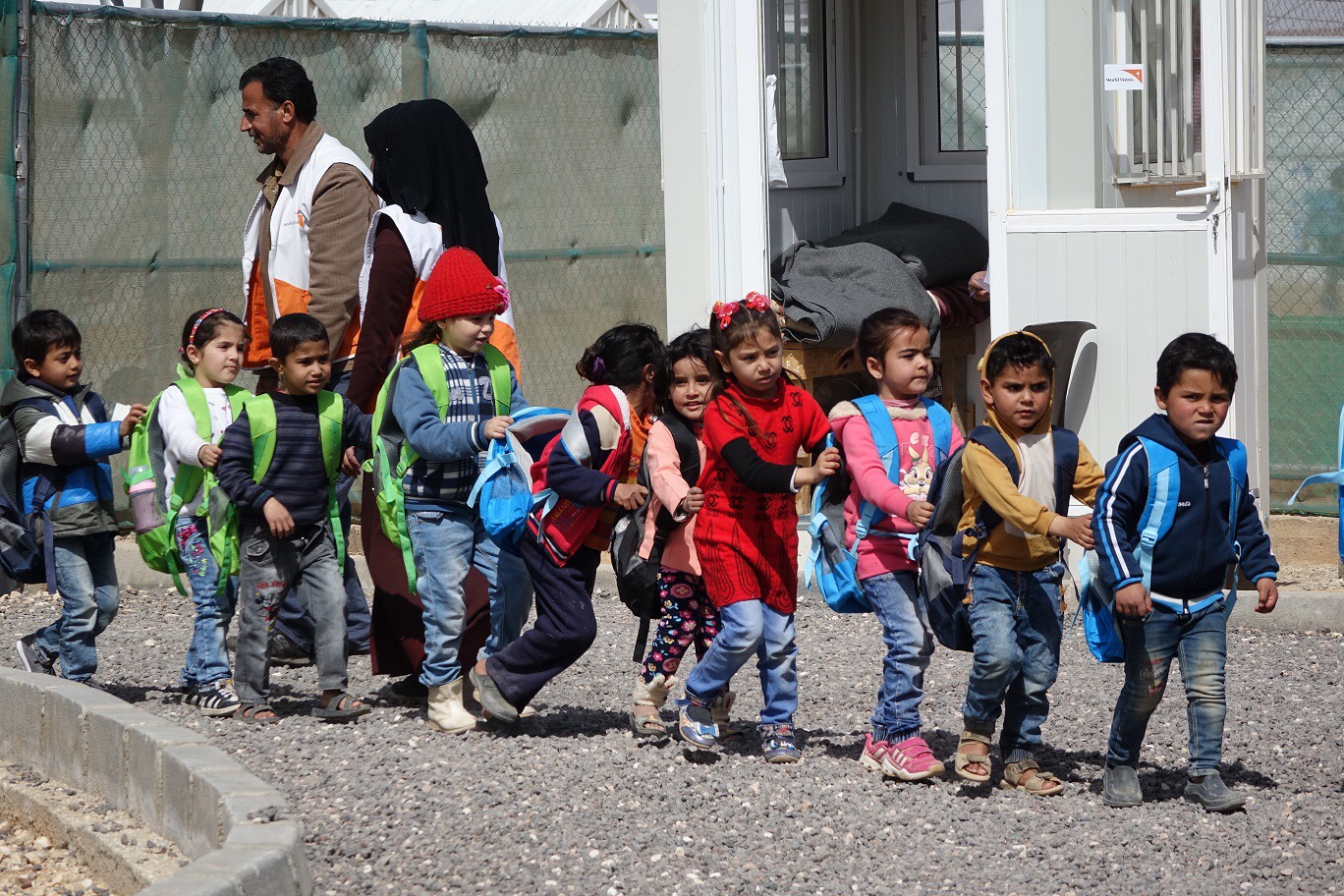
In addition to this, and funded in part by World Vision Australia, we partner with the World Food Program to distribute school lunches to over 7,000 children in six schools, every day. This is a vital part of the health program in the camp – and the kids love it!
I sit on the floor in Faisal’s home after visiting these programs in the camp. His wife has brought us coffee and sweet cakes, and we sit talking about life here in Azraq. Obviously he wants to be back home, in his house – if it still exists – but since that’s not possible he says, “you have to make life, you have to be happy”. Two of his children are at school and happy, his wife has friends around her and they support one another, he has some work (which subsidises the UN allowance) with one of the UN agencies. He is coaching sports and this coming weekend he will run his second marathon in Aqaba – a refugee entrant. Outside his house he has plastic containers with green plants hanging off the walls – this garden is his statement of hope in a restricted world.
Don’t misunderstand me, this place is not nice: just a few weeks ago it was freezing cold, wet and muddy, in a few weeks as summer kicks in it will climb up to 50C outside, but for too many people this (and places like it throughout Jordan, Lebanon, Turkey and Iraq) is home.

The Syrian conflict enters its seventh year this month and there is no end in sight. The selfish politics and greed of too many stakeholders seems endless and uncaring of the cost on ordinary Syrians. Faisal doesn’t believe he will be taking his family home anytime soon, and is thinking of how he can get them out to another country where there are opportunities and hope for the children. In the meantime, they continue to need our support to ‘make life and be happy’.


