Showing posts with label Development. Show all posts

Thursday, 9 August 2018

Paying it Forward

It was almost 15 years ago when World Vision Ethiopia, supported by Australian Sponsors, commenced Child Sponsorship activities in Kochere. Among the first, of what would be 4,000 children sponsored in this Area Program, was a young boy of 5 whose mother had died giving birth to his sister.

Over the years that have followed one generous Australian’s monthly pledge has supported ‘Wubshet’ through ten years of school. He has received school supplies, including text books, stationary and uniform, and this year, just a few months ago Wubshet passed his year 10 examinations and successfully completed his schooling. It is a very proud Dad (‘Haile’) who explains that Wubshet is not home, he is in Addis Ababa because he has just passed the entrance exams and been accepted into the Police force.

I’ve interrupted Haile and his (second) wife as they drive a pair of oxen to plough a new field that will be sown with barley. But, they are more than happy to stop for a few minutes and sit in the grass to tell me their story.

When World Vision came calling in 2004 Haile had not long ago buried his wife. He had four children under five and a small wooden shack in the valley. An offer to support his son and for him to receive training in agriculture seemed “like an answer to prayer from a great God”.

As part of the Area Program Haile received training in agriculture techniques, including potato and apple production and small business management. Over the years he has become so successful that he was invited by the government to be part of a farming trial of high yield variety potato. Part of the trial included him training others in the new techniques. Today he has a potato seed reserve bank that he manages and sells to the community. From the income he has made over the years he has moved to a new property, built a house and produce store, and planted out a large property with apple and banana trees, potatoes and coffee. Haile’s eyes light up though when he shows me his treasure, what he calls ‘holy land fruit’ – it turns out to be figs.

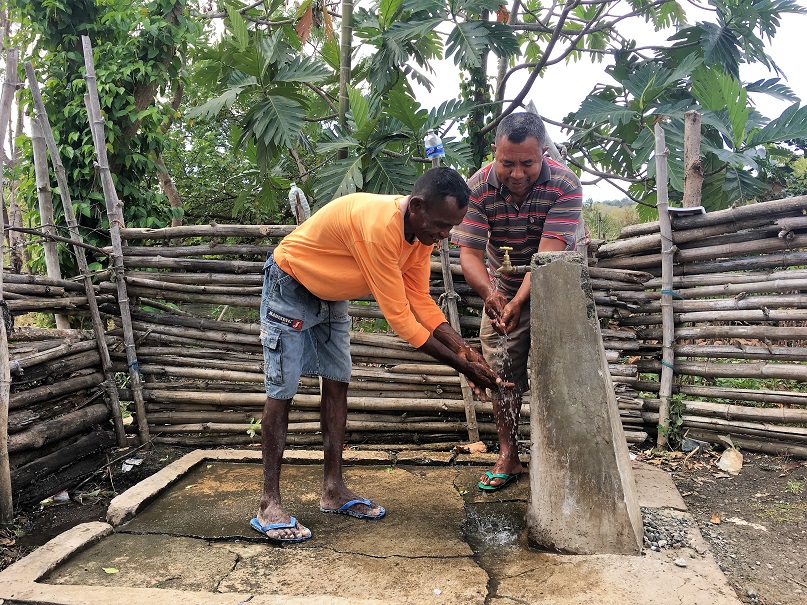
But he seems most excited when he tells me that for many years his children only had two meals a day, at the most. But now, his wife and their 12 children eat three meals a day and they drink clean, safe water from a community system supplied through Australian child sponsors funds.
Today, the ‘answer to prayer’ has provided him with hope that his son will be ok, he has a job, and it has changed his family’s life. But the impact of child sponsorship support has not stopped there.

Due to conflict in this region there are over 200,000 people displaced by tribal conflict in Haile’s district. Most of them are housed in schools, churches, local government properties and sports grounds throughout the district, but one family of ten, has found a safe home with Haile’s family. He has helped them to build a small wood house on his farm and he is sharing his food and resources with them, and they are helping him with his farming.

As he points out the small house in the shade of banana and coffee trees he tells us that ‘God has blessed him, and he must share that blessing with others’.

Thursday, 18 January 2018

Localisation Pick ‘n Mix

It’s easy and comfortable sitting in Headquarters passionately advocating for a commitment to localisation. After all, the theory of a localised approach to humanitarian action makes sense, we all agree that making our humanitarian action as local as possible and as international as necessary, will better address the needs of affected populations. That by engaging with local and national responders in a spirit of partnership and aiming to reinforce rather than replace local and national capacities we will deliver a more sustainable impact.
localisation means recognising, respecting and strengthening leadership and decision-making by local and national actors in humanitarian action, in order to better address the needs of affected populations.
Aligning our strategies with the World Humanitarian Summit imperative and ensuring a commitment by humanitarian actors to deliver on the theory is easy. It really does make sense and it is not as if it is a new initiative or principle. Governments and academics may have coined a new term and re-defined the principle – but most humanitarian actors (and many faith communities) have been committed to the principles of local ownership and action for decades. (Conversely, and in truth, as many governments and actors have not – a paternal, colonial approach is much easier and quicker.)

But then, one day the academic, the politician and the strategist visit the field! They spend time in a disaster-prone community, they meet a school principal who regularly evacuates his school because of flood, they meet with groups who support women who have experienced intimate partner violence. They meet real people, living in difficult and complex real-life contexts, within a community that is not as structured and supported as home. And, almost instantly, the champion of inclusive localisation theory, the passionate advocate of self-governance and ownership transforms into a paternalistic colonial. “Why are they still operating in that area if it is flooded regularly? Why haven’t you (the NGO) moved them? Why are you not making the government department move them?”

The gap between theory and practice is revealed in the field. I am a passionate advocate for localisation, always have been, whether we called it that or not, but it’s not as easy as you might think, and want. While it is a principle that can be mandated by donors and international stakeholders – it is not a practice that can be assumed, a mindset easily adopted or even believed in by all humanitarian professionals. When faced by the realities of injustice and inequity localisation is not often the first principle to jump to mind and practice.

You can’t pick ‘n mix what parts of localisation you like. You can’t mandate that all funds will go to local actors, but their decision on how to spend it will be subject to donor approval. You can’t pretend you are empowering the local government but then dictate how and where they will build facilities.

The principles of localisation are good and right, as international actors we must work to operationalise the theory, but let’s not pretend it’s easy and that we will always get the results we want, or think they should have. (Nor should donors imagine they will always get the quality of compliance or transparency they demand if they require localisation.) Giving people ownership, ensuring that they choose their priorities requires giving up my control and trusting them, even if I don’t agree. (And maybe working on informing their decisions and priorities through relationship and trust – not compliance.)

Friday, 22 December 2017

REFLECTIONS ON A POTHOLE

It’s about 10 meters long and 10 meters wide, it’s unavoidable and it’s infamous. It’s outside the Rove Police Station in Honiara (Solomon Islands) and it’s the reason why it takes over an hour to travel 6km home.

There is only one road through Honiara, west to east, and this is a section of it. So, when, because of the latest downpour it takes on the nature of steroid infused swiss cheese, when there are more potholes, (that is, craters) than there is road – drivers are forced to a go-slow – around, through and head on - in both directions. Until, one day the road is graded and, while it could not be called ‘carpet road’ it is flat and easily navigable.

There is now need for excessive caution or potential head on collision at 5 km/h and yet despite the fix, drivers still go slow, and meander erratically - as a result there is still a backup of traffic.

I have plenty of time to contemplate the pothole, and I wonder: are there some lessons to learn from the pothole for the industry in which I work? I think of a couple:

1. The road is apparently a never-ending cycle of repair and despair. Instead of a once and for all fix more sand and gravel is tipped in and flattened down; for a time it looks and feels good. The art of the quick fix.
If only it were that easy and yet despite the logic and the benefit of experience we do the same in the world of aid and development. It is so much easier and quicker, and often looks good on the nightly media round-up to lay down some dollars – feed some people, build a facility, pay off some debt. 
To fix the root cause and to invest in the foundation takes more time, more effort and potentially upsets some power holders. It is so much easier, and cheaper, to avoid upsetting the system and just fill in the potholes. Even if changing the system, addressing the root cause, building strong foundations, (sealing the road) could result in sustained and beneficial life change, (and in the end actually be cheaper). 
2. What fascinates me about the driving conditions after the road repair is that despite the fix drivers still slow down to crawl through as though nothing has changed. What does it take for people to trust the fix after so many false starts?  
People are desperate for help, desperate for hope - but frightened to trust, frightened to believe that anything has changed. Do people just become so used to the way life is that even when they can see a fix they are more comfortable being cautious? Making things look good is easy, changing behaviours is the harder route – it requires a reason, time and trust. 
Until we can convince people that the fix, and we, can be trusted why should they change their behaviour? (And here in Honiara, all we have proved is that the road fix cannot be trusted – two days after the fix the road is as bad as ever as the rain washes away the fill.)
Our job is to push back against the quick fix with the associated media grab and brand boost. There will be no lasting hope without trust and there can be no trust without results.

Sunday, 6 August 2017

The Star Thrower

795,000,000
people were suffering from chronic undernourishment in 2014-2016 (UNFAO)
66,000,000
forcibly displaced people worldwide
22,500,000
refugees, over half of which are children under 18 years old
3,100,000
45% of all child deaths, in 2011, were the result of undernutrition
28,300
people a day are forced to flee their homes as a result of conflict and persecution

THE WATER is a little choppy in the lagoon as the tide begins to turn, but I am determined to keep going – to reach my predetermined goal, before I turn around. Other than the sound of waves lapping against the paddle-board there is nothing, and no one, out here. The water is a translucent silver-green and below me I can see to the sea bed where brightly coloured and oddly shaped fish dart quickly from my shadow. In contrast to the manic fish, static among the coral and scattered like coloured confetti, are a multitude of star-fish - bright blue, red dotted, orange, green and brown - as far as I can see and for as far as I venture.

I am a long way from Darling Harbour Convention Centre in Sydney were recently I addressed a group of scientists on the subject of feeding the hungry in a complex humanitarian crisis. As part of the presentation I was asked to set the scene – to outline the scope of the global need. The numbers (above) are enormous, overwhelming and incomprehensible. The need is unprecedented in our history. As a result, for most, because the need and numbers are unfathomable we prefer to ignore, or at least excuse ourselves from the solution because ‘my little can’t possibly make a difference’.

Describing the context and rattling off the numbers in the comfort and excesses of Darling harbour is a far cry from where I am now, and where I have been in these last weeks. The statistics become personal in the eyes of the East Timorese child who will eat one meal a day, walk five kilometres to school and then go home to collect water from the river before helping her mum collect fire wood for sale the next day. Or in the story of the young Fijian boy who because of his disability was unable to get into the evacuation centre when the cyclone hit his village.

Four million Pacific Island people live in poverty – almost half the total population. Poor child and maternal health care, contaminated water, poor sanitation and a lack of education about nutrition are wasting opportunities, wasting lives and killing people. (Oxfam)

As I glide across the water with the uncountable number of star-fish below me, the sea breeze picks
up and I find it harder to make progress into the waves and the wind. I am reminded of the story of the Star Thrower (Loren Eiseley) and I am almost overturned by the prompt that I have a decision to make (again – because it’s a recurrent prompt). I can choose to be overwhelmed, throw my hands in the air with despair and ignore the need because the numbers are just too mind boggling, and the needs way to complex, or I can try to make a difference for that one boy, or that one girl that play in the dirt in front of me now.

So, like I did on the water, I keep going – often against the tide and into the wind – and I choose to make a difference – for that one.

------------

'It made a difference for that one'

Once upon a time, there was a wise man who used to go to the ocean to do his writing. He had a habit of walking on the beach before he began his work.

One day, as he was walking along the shore, he looked down the beach and saw a human figure moving like a dancer. He smiled to himself at the thought of someone who would dance to the day, and so, he walked faster to catch up.

As he got closer, he noticed that the figure was that of a young man, and that what he was doing was not dancing at all. The young man was reaching down to the shore, picking up small objects, and throwing them into the ocean.

He came closer still and called out 'Good morning! May I ask what it is that you are doing?'

The young man paused, looked up, and replied 'Throwing starfish into the ocean.'

'I must ask, then, why are you throwing starfish into the ocean?' asked the somewhat startled wise man.

To this, the young man replied, 'The sun is up and the tide is going out. If I don't throw them in, they'll die.'

Upon hearing this, the wise man commented, 'But, young man, do you not realize that there are miles and miles of beach and there are starfish all along every mile? You can't possibly make a difference!'

At this, the young man bent down, picked up yet another starfish, and threw it into the ocean. As it met the water, he said, 'It made a difference for that one.'

So, can I encourage you to take the time to do something that will make a difference to someone else's life ... and it doesn't have to be much and they don't need to know. Just take a moment, do something special.

[Adapted from The Star Thrower, by Loren Eiseley (1907-1977)]

Friday, 28 July 2017

The Impact of Water

 A lack of rain, resulting in a dry and dusty drought has become the norm for most of the inhabitants of Timor Leste and has resulted in a drastic change of lifestyle for many.

After travelling 70km, which took three hours along terrible roads (when does a road lose the right to be called a road?) with some stunning views, I arrive in the district of Baucau, in the sub-village of Caicua. The greeting is warm and the coffee is sweet, and as we sit speaking about the challenges and the past, Luis, the Caicua village chief, expresses thanks to World Vision and the Australian people for the (literally) lifesaving interventions that have meant, among other things, that water is available for some within ten meters of their homes.

In years past, the majority (80%) of Timorese people were engaged in agricultural livelihoods, with most of these working their own subsistence farms. (In 2009), about 67,000 households grew coffee, with a large proportion being the poorest. Before the drought, when there was water, many in Caicua grew rice which fed their families and supplied some extra income. But when the rains stopped, so did the paddy field yields. Today most of the village relies on gathering firewood to sell in larger markets and the harvesting of palm tree products for building materials and consumption.

Life has changed for the villagers; those that stayed have adapted their lifestyles to the new reality, but many have left and moved to larger towns where water is still available.

World Vision, with Australian Government (DFAT) funding began operating in this district in 2009, before the drought, but in the last two years together with the community World Vision has established new water points, trained people in appropriate farming methods, value add food processing, and financial management through savings groups.

The impact of the supply of water should not be underestimated. Following one of the possible
‘impact chains’ reveals that the results of the water include: adequate water supply for household needs (drinking, cooking and cleaning) and home garden use: resulting in increased and diversified garden yield: which improves family consumption and health (increased vitamin A, iron and protein) and provides surplus yield available for market: which increases household income: ‘extra income’ can be invested in village savings groups (70% of members are women): meaning that children can attend school because parents can pay for school uniform and school resources. Impact? Children are educated: children are healthier: Children and their parents have better likelihood of living life in all its fullness.


Monday, 8 February 2016

Zika: Fast & Furious

I have to admit, as insensitive as it will sound, that when I heard last week that the Brazilian military were set loose on the favelas of Rio and Recife, searching out and destroying potential breeding spots for mosquitos that my mind went immediately to the movie “Fast & Furious 5”. I can see Vin Diesel and The Rock stomping through the narrow alleyways, chasing each other over the roofs and dodging flying cars all in the hunt for the elusive Zika Mosquitio.

Sorry for the insensitivity of the detour of my mind - it is so much more frightening and serious than that. When WHO director general, Margaret Chan called Zika an "extraordinary event" that needed a coordinated response she was acting on the knowledge that this virus, with its genesis in the mosquito, is already impacting millions of people and has the potential to spread and affect millions more. This is a public health emergency of international concern." (Announcement)

One clinic in Recife, a run down, underfunded medical facility was treating maybe 5 cases of microcephaly a month, until last month when they treated 300. While the medical evidence, (hard data) is still not available to say that the virus causes microcephaly the anecdotal evidence and the belief of most, especially the mothers of the affected babies, is that the link is undeniable.

We operate in 14 countries in Latin America but we are prioritizing interventions in the most affected countries of Brazil, Colombia, El Salvador, Honduras and Guatemala. Brazil is the most affected, with over 4,000 suspected and 400 confirmed cases of microcephaly caused by the Zika virus among newborn babies, according to the country's health minister. In the next six months the estimated budget for our response is US $3 million to reach 300,000 direct beneficiaries and 1.5 million indirect beneficiaries in the five countries targeted.

The frustration for Brazilian’s must be that this virus has been around for years, microcephaly and the link has been investigated for at least the last 18 months, but when the world begins to focus on the Olympics and athletes (especially young women of child bearing years) from all over the world, when the virus looks like it could perhaps jump Dutton’s border security, avoid off-shore incarceration and take residence among us – then we take notice.


There is information available, and you can follow our progress (and contribute to the effort to assist the people of Latin America if you’re able). 

Tuesday, 5 May 2015

The Feast

A Maronite, A Shiite, A Sunni and a Christian Evangelical walk into a Restaurant…

Sounds like the beginning of a joke, but this is no joke – 9 young people and their leaders from all four religious groups are meeting together over a meal. These people are supposed to be enemies, they are supposed to be so suspicious of each other that this can’t work – but it is.

The Feast is a model of interfaith dialogue for young people. Originally from the UK, it is being trialed here in Beirut, and from what I can see from the genuine friendships between the young men and women around me – there are no barriers here. Two young women, one Evangelical and one Shiite are having a discussion about the different head coverings worn by the two young Shiite women. Patiently and with passion the Shiite is explaining the differences and the part that fashion plays in her selection for tonight. At the same time a Maronite and a Sunni are comparing notes from a lecture on Middle Eastern politics they had earlier today.

These 9 represent 24 other young people, between the ages of 15 – 19, who have been meeting for a couple of months now. They meet over a meal, but not just to eat – although one of the young men assures me (with a wry smile) that’s the important part. They meet to share their lives and to talk about their faith. There are strict guidelines for their engagement, but Ali tells me they are ‘just common sense and decency’.

One of the objectives of The Feast is all members working together toward a common project. At the moment this group is discussing what that will be, but they are thinking about helping a local orphanage or maybe doing something for Syrian refugee children.

This type of dialogue and bridge building is essential. It is one of the best hopes we have for peace and stability in this region, and wider. Imagine if instead of suspicion and hatred there was understanding, respect and celebration. The young people I had dinner with are proof that it can work.

Sunday, 3 May 2015

In the Shadow of Anti-Lebanon

The winter snow melt has left the pine clad mountains surrounding the city green and lush under a clear blue sky on this beautiful spring morning as we head east away from Beirut and the Mediterranean and over the Lebanon mountain range toward the Syrian border. Once through the mountain pass we look down into a stunningly beautiful green valley. This is the Bekaa Valley and it is here, at the foot of the Anti-Lebanon mountains (the border between Syria and Lebanon) about as close to the Syrian border as you can get, that hundreds of Informal Tented Settlements (ITS) have appeared over the past four years.

Since the Syrian civil war started in March 2011 over 1.5 million Syrians have fled from the bombs, the bullets and the death to settle in Lebanon. Around 420,000[1] of these people live in ‘tents’ in the agricultural communities of the valley.[2]

I arrived in one of these ITSs yesterday morning as a van load of children returned home from school. As they poured from the back of the van they were laughing, shouting and teasing one another – they seemed liked kids anywhere, they were happy! But as I looked around and as one of these families shared their story with me, I wondered why.

Omar and Anila[3] and their 9 children came across the border from Syria 15 months ago. For over three years they lived with the uncertainty of the war in their homeland, but then “the bombs began to be too many and too close” (Omar). Arriving in the Bekaa, Omar and Anila joined 67 other families, (a community of 428 adults and children) on a 1 acre property and built a 2 room shelter from wood, cardboard and tarpaulin for which they pay a rent of $400[4] a year.

Today, as I sit in their lounge room with clean straw mats and cushions bordering the tarpaulin walls, it is cool and quite comfortable. They serve me a cup of Arabic coffee - strong, thick and black it will keep me buzzing for a while. But only a month ago there were floods here from the snow melt, and in the weeks before that most tents were buckling under the weight of heavy snow. It must have been unbearably cold and wet.

They have electricity, some of the time, but they pay $45 a month for that. Each tent is supplied with a 1,000 liter water tank and 1 voucher a week to refill it. (That's about 3.5l a day, per person for Omar and his family). They have access to a toilet for every 15 people, and 2 vouchers per month to have the septic tank emptied.

The oldest son is the sole income earner for the family, working for about 6 months of the year in the surrounding farms he will make about $25 a week. This, together with a World Food Program allowance of $19 per person per month and a small allowance from the UNHCR is the entire income. Omar tells me that due to visa issues (costing $2,000 per person per year) he is unable to work. He is frightened that if he leaves the property he could be detained and returned to Syria.

The four middle children are picked up with other children to attend a UN school a little way from the settlement and the three youngest children attend a child friendly space on the property. The oldest boys, all who were studying back home, now cannot attend school and have nothing to do.

One of her youngest uses her as a climbing frame whilst keeping a wary eye on this strange man in her house, as Anila tells me that she fears for her children; if one of them becomes ill there is no care available, even if she could afford it. Often there is not enough food and so they have to purchase food to credit. 

Omar dreams of the day that he can take his family home, “even if our house is gone, I will build a tent like this and we will be home – but for now what choice do I have? Inshalllah, one day soon, it will be safe to go home, but at the moment, even if I could go home I wouldn't because my boys would be forced to join the Army."


[1] http://data.unhcr.org/syrianrefugees/country.php?id=122)
[2] An estimated 9 million Syrians have fled their homes since March 2011. According to the United Nations High Commissioner for Refugees (UNHCR), almost 4 million have fled to Syria's immediate neighbours Turkey, Lebanon, Jordan and Iraq. 6.5 million are internally displaced within Syria. (http://syrianrefugees.eu)
[3] Names changed.
[4] All dollars are USD.

Saturday, 28 February 2015

To Survive or Thrive

A couple of years ago Maysa Al Hosomi (now 28 years old) was desperate. She had three beautiful little girls and her husband was finding occasional work; they were surviving but by no means could you say they were thriving. But, Maysa was determined to be able to provide better for her girls and she was not going to sit around waiting for handouts. She heard about a local women’s Community Based Organisation (CBO) that was operating in her neighbourhood and went calling on them to find out what they did and who they did it for.

As a result of this introduction she was invited to participate in some training sessions including entrepreneurship for women, income generation and Mental Health and Psychosocial Support (MHPSS). Following these trainings she put a table outside her house and sold some basic grocery items. But, having got a taste for some possibilities, she was dreaming much bigger, so she approached our staff to find out what she could do next. Her dream was to open a grocery store and after presenting a business case she was accepted into the Youth Entrepreneurs program. This partnership required her to be able to provide the space for her shop, with that our partners would assist with some of the basic shop fittings, (shelving, counter and a fridge).

Today the front room of her house is a clean, well organised, well stocked store selling all kinds of daily necessities and some luxuries. In the couple of years that she has been operating she has used her profit to buy a freezer which she stocks with fish as her community is a distance from the coast; she has purchased a second drinks fridge which is stocked with all the usuals; and she has computerized her accounts by teaching herself Excel and training her husband how to use the system.

Maysa and Mohammed are by no means rich, but as a result of a small investment from Sponsors and Maysa's hard work and determination to thrive, they make a ‘nice profit’ and are able to provide for their (now) four girls.


Video Translation:

Nour, 12: "Thanks to World Vision for supporting us to have our family small business, this helped our father to buy for us the things we like.”
Safa, 10: "Our father started to bring us nice clothes."
Fatima, 8:“Also, our father now gives me and my sisters’ money every day.”
“Thanks World Vision, we love you so much”

Monday, 5 January 2015

Latin America & the Caribbean (LAC)

The other region I am privileged to work in is, Latin America and the Caribbean. Here's a short intro to what we call LAC:

Our cause: Protected children promoting a more just and secure society.

Latin America and the Caribbean is the most urbanized region in the developing world, as three quarters of its population residing in cities and surrounding areas (World Bank, 2004).

UNICEF's "State of the World's Children 2005" reported that 44% of the population of Latin America and the Caribbean live below the poverty line, this rises to 56% among those under 19. About 27 million Brazilian children, who live below the poverty line, are in families with incomes below $100 per month.

The fight against poverty requires actions and solutions that should be implemented in all areas of society. Poverty can be reduced through policies that promote responsible government, support for micro, small-scale agriculture, income equality and access to credit, education and training. It should ensure equal opportunities for boys, girls, youth, women, the neediest communities and indigenous peoples.

World Vision seeks to improve the quality of life for children, families and communities through development and community organization in the region. Improvement of roads and housing, construction of plazas and parks recreation and drinking water facilities, drainage and irrigation, electricity facilities are achieved with the active involvement of the communities served.

World Vision's work in this region is divided into three clusters:
  • Central America: Mexico, Honduras, Guatemala, El Salvador, Nicaragua and Cost Rica
  • South America: Colombia, Ecuador, Peru, Bolivia, Chile and Brazil
  • Caribbean: Haiti and Dominican Republic
At present, World Vision is working across a diverse and dynamic region to improve the lives of nearly 14.5 million of the most vulnerable children in Latin America and the Caribbean.

Monday, 29 December 2014

Middle East and Eastern Europe Regional Office (MEERO)

I have the privilege of championing the work of World Vision Australia in two regions: Latin America & Caribbean (LAC) and Middle East and Eastern Europe (MEER). Here's a short introduction to what we call MEER:
______

The countries where World Vision works across the Middle East, Eastern Europe, Caucasus and Southern Asia region are of huge geopolitical significance.

This is a region where the children, families and communities face staggering challenges every day—challenges that all too inevitably force some children to grow up too fast while not allowing others to grow up at all.

While there are differences in the struggles faced by the children and their families depending, in part, by what country they call home, there similarities as well. Across the region, World Vision is working to provide millions of children: with access to a quality and affordable education and health services as well as knowledge of their rights and a means to protect themselves from those who would exploit them. At the same time, World Vision strives to come alongside parents and community members equipping them to be able to provide for their children’s physical, spiritual, intellectual, and emotional needs regardless of ethnicity, gender or religious beliefs both now and in the future.

World Vision’s work in this region is divided into four clusters of countries:
At present, World Vision is working in more than 1,500 communities across the region striving to improve the lives of nearly 10 million children and youth.

Friday, 31 October 2014

Adeline, a Camp Sodom Survivor

I was making my way through the narrow alleyways dodging the electrical wires that snaked their way through the concrete houses and house front stalls that cling to the sides of the mountains above Port-au-Prince. The kids were yelling “Good Morning” and waving as I passed, the adults eyeing me with perhaps just a little suspicion.

I was on my way to meet Adeline Eliazard and her three children, Nadine Andrice (17), Ernst Andrice (15) and Jerry Andrice (13). With the help of World Vision International Haiti and funds from World Vision Australia, she and her children have been living in a 2 room concrete bunker type house (maybe 40m2) in this densely packed community since December last year. But the four years before that had been very different and very difficult.

On the 12th day of January 2010 a 7.0 magnitude earthquake that lasted about 35 seconds destroyed her home and all that she possessed. And due to a lack of access of care, Adeline’s husband died on January 13, 2010. It was a devastating time for her and her young children.  In the days before the quake, Adeline, despite a heart condition that required treatment, was just making ends meet. She sold cooking oils and made enough to keep her children in school, feed them, and together with her husband’s income they were able to afford the rent.

Following the quake Adeline and her kids, with 69 other families, moved onto a plot of land (about 400m2) bordering a ravine at the bottom of the mountain. She salvaged all she could from her home, not much, and with NGO handouts, set her self up in a tent/shack – this was going to be home for the next 4 years.

Their community was named Camp Sodom; I can imagine it being a horrible place to live. The day I visited the camp site which was now empty, it was hot, 45C; no trees, no shade, the ground is rough gravel and dirt – it is hot, very hot. Sometime time later, in the first year, an NGO built a toilet block but there were no other facilities at this camp. During the 4 years, Adeline’s sister helped her with some rice and beans every fortnight or so, but she had no other source of income and she couldn’t afford the fees to send her kids to school – the choice was food or school.

Sometime in 2013, the owner of the land decided he wanted his land back so, to encourage families to move away, he had the toilet block demolished. For almost a year, Adeline now laughs as she tells me the story, “we did the toilet in plastic bags, but not everyone was so thoughtful”. The owner also employed more direct methods to encourage the people to move.

By the end of last year, Adeline was desperate and completely demoralized. She and her kids had lost so much weight that, as Adeline thinks back, “I looked like a stick. I prayed, God deliver us from this place, show me some hope, please God do something to help”.

That same month she saw some new faces in the camp. World Vision International Haiti, with the approval of the Mayor’s office had come to her camp to ‘transition’ people out, close the camp and return it to the owner. This was a government-sanctioned approach that all NGOs are using in Haiti that provides grants for families to find and rent an appropriate rental property for one year and to set themselves up in some kind of small business.

Adeline wasn’t quite sure what it meant, but for the first time in a long time she saw a glimmer of hope. “When I saw and heard Rolande and the World Vision team, I had hope that my children would be delivered and that we could get out of this place. It was the first time I had hope in a long time.”

Today, almost 12 months later, I am sitting with Adeline and her children in the curtained of front entry of her little concrete house on the mountain, looking down on the land that was her home for 4 years; she smiles lots, despite the tears in her eyes as she retells her story, she is happy and she laughs often.

She now has a small business making and selling peanut butter; she has enough income to enroll her children in the new year of school that starts next month and to buy food. Brand new, pressed uniforms hang wrapped in plastic on the wall waiting for the day that she never dared to imagine would come.

With her sisters help Adeline has managed to get medical help for her heart condition and she is doing ok. Her children are happy: Nadine Andrice is a beautiful young woman, shy at the moment with me in the room, but she has friends in the closely packed community; Ernst Andrice is also shy but he sits protectively close to his mum – he has a look of warning, ‘don’t mess with my Mum’ in his eyes; and Jerry Andrice swaggers into the room, braided long hair and a big confident eye-sparkling smile, he slaps my hand in a high five as he sits down next to me.

A little concerned about what happens after the one-year rent grant is exhausted; I ask Adeline where she will get rent money next year. “I don’t know”, she says, “At the moment I only have enough for food and school, and without a husband to help it is tough. But God will provide, I am praying that God will provide”.

When I was here in an earthquake recovery capacity (for The Salvation Army) 4 years ago, the city was a mess, there were about 1.5 million displaced people, today there are reportedly about 55,000 people still living under temporary shelter in camps. But the majority of camps have been closed and cleared. There are public spaces once again available to and used by the people. People are living back in the communities, some in better conditions than they had before the quake. The sides of the roads are lined with smallholder stalls selling fruit and paintings.

But this 5 years of unprecedented investment at best brings Haiti back to where it was before the quake –it is still the poorest country in the western hemisphere with about 77% of people living below the poverty line. The majority of Haiti’s people are still in need of help – perhaps we should join our voices and hope with Adeline’s prayer, “God provide for your people”.

Daryl Crowden

August 2014

Monday, 29 September 2014

“Opposing apartheid was a matter of justice, opposing discrimination against women is a matter of justice. Opposing discrimination on the basis of sexual orientation is a matter of justice. It is also a matter of love. Every human being is precious. We are all - all of us - part of God's family. We must all be allowed to love each other with honor.” (Desmond Tutu)


Secular narratives of social transformation are often separated from religious narratives of personal transformation. This division ignores the lived realities of people who are struggling for change.

We enter the police station in a mid-size town in KwaZulu Natal, South Africa, knocking on doors to find the officer who’s agreed to be interviewed for our research on spirituality and social transformation. A few minutes later, one door opens. “Hello, apologies for not responding, I was having my moment of prayer, but come in”, says a female warrant officer. We enter her small office. A laptop on a shelf is playing a video with a pastor giving a sermon. A document about “spiritual warfare” is pinned to the wall.

We’re here to find out her views on the role of religious faith in efforts to realize gender equality in contexts where women occupy inferior positions in their households, and where they are regularly exposed to the threat of rape and other forms of violence. A 2012 report from the South Africa Medical Research Council reports that a woman is killed by an intimate partner every eight hours; 37 per cent of South African men admit to having committed at least one rape.

In response to our questions, the warrant officer tells us: “I believe we cannot fight crime without the involvement of the power of God. Churches play an important role...first of all through prayer because fighting these crimes should start spiritually. In addition, faith leaders and churches could also contribute to raising awareness on these issues.”

For her, as for many other people we interviewed, fighting gender-based violence is first and foremost a spiritual issue. No distinction is made between the warrant officer’s public role as a keeper of the peace and her personal faith, a lack of separation that would raise suspicions in other, secular settings. Those suspicions are well founded given that religion has been a force for social injustice as much as social justice, so what is it that turns faith in one direction or the other?

Why do some religious leaders feel compelled to support social change while others don’t? Does the answer lie in a particular reading of religious scripture, or in the spiritual experiences that may underpin religious convictions, or in the feelings of universal love that faith and spirituality sometimes awaken, or in some other factors entirely?

The argument that religious and secular perspectives do not mix is well rehearsed, especially in the world of international development. After all, the goal of ‘development’ has largely been based on a grand narrative of modernity and progress which privileges economic growth, liberal democracy, individual liberty and a secular public sphere - moulding ‘developing’ societies into the image of the West.

Most development success stories are embedded in such secular narratives, even though leaders from the global South like Mahatma Gandhi, the Dalai Lama and Nelson Mandela have written and spoken about the extensive role that religion and spirituality have played in their own journeys. Religious narratives make development practitioners uncomfortable. Not only do they emphasize the personal dimensions of social change that the development industry tries to avoid, but they also bring elements of religion and spirituality into public discourses that many of those working in this field would rather see disappear.

But in our conversations with community leaders, religious figures, teachers, police and others throughout Southern Africa, personal and social transformation emerged as closely-intertwined realities. Religious and secular dynamics are inextricably entangled. This raises significant questions for scholars, policymakers and activists who want to support participatory, democratic development whilst continuing to exclude the spiritual dimensions of life and work from the mainstream agenda.

Conversely, religious actors have frequently failed to connect personal transformation with broader processes of social change. In the Pentecostal churches that have grown so quickly in many parts of Africa, for example, membership has proven to be a positive influence on personal agency. But the idea that such agency should also contribute to the pursuit of social justice is often absent from the perspectives of the churches’ leaders, particularly those who come from conservative theological frameworks which emphasize the primacy of personal salvation. This perspective has frequently been at odds with more theologically liberal frameworks which stress the inclusion of diverse and marginalized voices, and the transformation of personal and community identities.

Yet this tension may be abating as faith-based development organisations begin to adopt approaches in which social and spiritual considerations are joined together. One example is a program run by World Vision International called “Channels of Hope for Gender,” which uses scripture to promote equality between men and women who profess a religious faith. A Pentecostal pastor in Malawi who participated in the program along with 1,260 other people throughout Southern Africa in 2013 told us how reading the Bible in a different manner encouraged him to change the way he acts towards women. “We saw the Bible as one story,” he said, “but now we see that there are different voices, and we need to listen to the voices about what is good in men and women.”

To assess the impact of the program we spoke with other people in the community, including a husband and wife called Ruth and Joseph who run a number of small business enterprises. Joseph keeps livestock and runs a grocery store and tea-house, while Ruth runs a successful tailoring business. It was her success that enabled Joseph to start his own enterprises.

When Ruth was first invited to participate in the gender equality workshops, she and Joseph decided that she was too busy, so he attended instead. They say that the training has resulted in significant changes. Joseph now takes an active role in the household - cooking, cleaning, fetching water, and looking after the children if Ruth is busy with customers. Previously Joseph made all the decisions on household finances, but now the couple make them together. They see themselves as role models for the rest of their village, visiting and speaking to other members of their community about gender equality and what it means in practice.

Later, Ruth commented to us privately that although she really wanted to attend the workshop herself, she knew that Joseph needed to undertake the training much more than she did. She added that before the workshop, Joseph “was not a praying man, now he prays all the time.” From her perspective, Joseph’s spiritual transformation and the transformation of roles and relationships in her family are part and parcel of the same process.

While the program doesn’t always result in such clear and positive changes, this story and others like it highlight how experiences of personal transformation can provide the motivation to engage in broader action for social change. By contrast, recent interest in religious leaders as potential partners in development work has been highly instrumental, focused mainly on religious leaders and their organisations’ capacities as ‘delivery systems’ for services like health and education, and measured against secular criteria that exclude the spiritual, transcendent and metaphysical aspects of religiosity. While the move to engage with religion is promising, this narrow focus risks ignoring or marginalizing the deeper ways in which spirituality is bound up with social transformation.

Timothy Keller for example, the Senior Pastor of Redeemer Presbyterian Church in New York, believes that a personal experience of God’s grace is key to an awareness of, and sensitivity to, issues of social justice: “as I preached the classic message that God does not give us justice but saves us by free grace,” he writes, “I discovered that those most affected by the message became the most sensitive to the social inequities around them.”

Similarly, Gary Haugen, the founder of the International Justice Mission, declares that “seeking justice is a straightforward command of God for his people and part of Christ’s prayer that his Father’s will be done ‘on earth as it is in heaven,’” so a relationship with the divine is critical in many people’s decision to participate in the pursuit of social transformation. Religious leaders we spoke to in Malawi and South Africa also emphasised God’s love for all humanity as a critical factor in changing their perspectives on male/female relationships.

Archbishop Emeritus Desmond Tutu has emphasised this calling many times: “Opposing apartheid was a matter of justice,” he writes in The Huffington Post, “opposing discrimination against women is a matter of justice. Opposing discrimination on the basis of sexual orientation is a matter of justice. It is also a matter of love. Every human being is precious. We are all - all of us - part of God's family. We must all be allowed to love each other with honor.”

[Brenda Bartelink and Erin Wilson 17 September 2014:

The Gaza Strip

The Gaza Strip is one of the most densely populated areas in the world with about 1.8 million people confined to 365 km.[1] There are about 4,505 people/km2, which is expected to rise to 5,835 by 2020. (In comparison: 2,050 people/km2 in New York City.[2]) Approximately 50% of Gaza residents are children[3]. The area is completely fenced in on three sides, and access to the Mediterranean Sea has, only recently, been increased to a maximum of 6 miles off shore for fishermen.

Israel controls access of people and goods at two border crossings- Erez and Kerem Shalom, and controls all air and sea access. Egypt controls the access in and out at the Rafah crossing. Gazans can only enter Israel at Erez with a rare Israeli military permit or through unpredictable and long lines through Rafah into Egypt. Kerem Shalom is reserved for the movement of commercial supplies/goods.

In 2007, following the Hamas election and subsequent takeover of the Gaza Strip, Israel severely increased closures and restrictions. Gazans survive on foreign aid, the tunnel economy, and remittances, but with 80% reliant on foreign aid[4], this blockade has pushed the population further into poverty, particularly in its restrictions of goods that are allowed to enter. Malnutrition among Gaza’s children is not improving, particularly for those under 5 years. About half of infants and children under 2 years old have iron deficiency anemia.[5] According to UNICEF, one fourth of children under 5 years old are anemic and 10% of children in Gaza are stunted.[6] An end to the blockade offers the prospect to improve child health and nutrition in Gaza.

Restrictions on Freedom of Movement

The blockade affects virtually every facet of life for Palestinians in Gaza, including traveling between and within the Occupied Palestinian Territories (oPt), educational and employment opportunities, and the ability for families to visit one another and live together in peace and security. Palestinians living in Gaza require Israeli permits to enter the West Bank, whether they enter via Erez or from Jordan through Allenby Bridge, the Israeli controlled border crossing between Jordan and the West Bank. There are no other possible routes for Palestinians in Gaza to enter the West Bank.

The Israeli authorities hold complete control over the Palestinian population registry.[7] They have the ultimate say over any address changes, changes in residential status, and the ability to travel. This “separation policy” is enforced by a complex system of identity cards that Israel uses to separate, identify, and monitor Palestinians from the West Bank, Gaza, and Jerusalem. This is largely contributing to the fragmentation of Palestinian society.
_______________________________________

[1] United Nations Development Programme, “Facts about the Palestinian People,” http://www.undp.ps/en/aboutundp/aboutpalpp.html.
[2] “Life in the Gaza Strip,” BBC, November 22, 2012, http://www.bbc.co.uk/news/world-middle-east-20415675.
[3] Gaza in 2020 A liveable place? http://www.unrwa.org/userfiles/file/publications/gaza/Gaza%20in%202020.pdf
[4] Amnesty International, http://www.ynetnews.com/articles/0,7340,L-3894847,00.html.
[5] World Health Organization, “Health conditions in the occupied Palestinian territory, including east Jerusalem, and in the occupied Syrian Golan,” (Report by the Secretariat, May 11, 2012), http://reliefweb.int/sites/reliefweb.int/files/resources/Full_Report_3973.pdf, 2.
[6] Gaza Facts and Figures- UNICEF oPt- November 2012, http://www.unicef.org/oPt/UNICEF_oPt_-_Gaza_Fact_sheet_-_November_2012.pdf.
[7] For more information, please see Human Rights Watch’s 2012 report, “Forget About Him, He’s Not Here”: Israel’s Control of Palestinian Residency in the West Bank and Gaza,” http://www.hrw.org/reports/2012/02/05/forget-about-him-he-s-not-here.

Friday, 22 August 2014

Rag Doll in a Cement Mixer

Isle de La Gonave
Like a rag doll in a cement mixer, so was the Tuesday of my visit. The day starts with a pleasant, short 20-minute flight in a Missionary Aviation Fellowship airplane across the water to Isle de La Gonave. We climb steadily through the smog to 4,500 feet only to push the nose to the ground as soon as we reach altitude. On approach to the island we pass over the top of beautiful calm, clear, turquoise water dotted with small fishing boats and coral islands guarding the coast. All of a sudden the dirt strip on the beach is in front of us; it should have been an indication of what was to follow.

About 60km off the coast of the main island La Gonave has seen little investment over the years. There is one carpet road, about 250m long from the harbor to the main town of Anse A Galets. The rest of the island’s 200km road system varies between a few meters of nice smooth sand to extreme, rocky, four-wheel drive. The community I was heading for, Nan Café, is a bone jarring 22km and 2 hours away amongst hills clothed in avocado trees and carved out of limestone.

We have been working in these hill communities since 2002 and over the years we have worked with the communities and other partners to ensure access to schools for about 95% of the children with an increasing percentage of girls staying in and finishing school. When we arrived on La Gonave there were 3 clinics and 1 health care professional for the island’s population of 83,099 people. Today we have established and handed over 9 clinics to the government and there are 22 health care professionals serving the communities throughout the island. The statistics for health problems as a result of poor sanitation have decreased, and household incomes have increased because of improved agriculture practices, fishing techniques, vocational trainings and charcoal production. (Instead of cutting down the whole tree people have learned more sustainable ways of harvesting the wood.)

Much has improved but there is still so much more to do. The school attendance is high, but the percentage of children that can read and write at the appropriate level for their age is very low, much needs to be done to raise the quality of education. I met with 20 young people who told me the stories of their schools and communities. All of them are in or have finished school – an improvement – but then what? With our partners we have provided some vocational training but there are not enough jobs on the island. Despite that the young men and women still want to learn to be plumbers, electricians, tailors and of course, IT gurus.

Port de Bonheur, La Gonave, Haiti
This program has 3 years to go before we close out, but right now, after 12 years in the community we are planning and working toward the transition to sustainability and complete community ownership. Are they ready to continue on their own, can they do it? Their answer: “of course we can, and we must, our families futures depend on it.”

Australian sponsors support about 6,700 children in three development programs, (Grand Lagon, PACODES and Port be Bonheur) on La Gonave. If you are one of them I can tell you, after visiting all three programs, that you can be proud of what the children and their parents have achieved – lives are being transformed and hope is growing stronger.

Tuesday, 19 August 2014

Return to Haiti

I look out my window and there is a wall of pastel coloured houses climbing up the mountainside, it
looks to me almost like a Lego construction, gone a little wrong. The houses seem impossibly conjoined, wallpapering the mountainside like a 3D image.

I must admit it's not the image of Haiti that I remember from my time here in 2010. I saw them then, and I remember commenting on how so much of this seemingly fragile community survived, but at that time I was concentrating on the destruction in the valley and the city below these houses. A lot has changed in 4 years, both for me and for Haiti.

Four years ago I spent 8 weeks here with the Salvos: an amazing group of people served a community of 20,000 displaced people in Delmas 2 and initiated numerous other recovery and rebuilding programs. (Have a look at my blogs from July/August 2010) Today I returned with World Vision and I come to see the work (about 6,500 children and their families are supported) that Australian's support on La Gonave, an island just off the mainland, and to finalise the transition process for a displaced people's camp in Port-au-Prince. There are still about 100,000 people in temporary housing.

The unprecedented outpouring of funds to the country has ended, the influx of every kind of NGO and Aid provider has retreated, the country that was the poorest in the western hemisphere is still the poorest, the people are still amongst the most vulnerable and there are still people here, very passionate, committed people wanting and trying to make a difference. The Salvos are still working in areas no other NGO will go, including World Vision;  World Vision is still working in some of the poorest and most vulnerable Haitian communities that have been ignored by Haiti's own systems.

As I drove into town from the airport some of my first impressions included: the condition of the roads are still amongst the worst I have ever travelled on; the traffic is still utterly chaotic, at one point on a road two lanes wide 4 lanes are created, 3 going into town and 1 out, before they all try to merge into one to enter a roundabout; there are open areas where 4 years ago there were thousands of temporary houses; there are small piles of rubble, cleared slabs and some new buildings going up where there were huge piles of rubble and there are still white UN vehicles driving like they own the roads.

The problems associated with the 2010 earthquake are innumerable, but amongst them is the fact that many seem to be acting like they have done their bit, they have given much to Haiti and now it should be fine and there are so many other places in the world that need help. But Haitians still need help, children still need access to quality education and health systems and parents still need help to improve their capacity to provide for their children.

Friday, 8 August 2014

Participatory Grace

This morning at home in Melbourne, before standing under a wonderful warm shower, I filled the kettle from the tap and boiled the water without fire. And I was thankful!

Not so long ago I sat in the shade of a tree with a small group of people who have no taps in their homes – in fact some have no ‘home’, but rather a concrete or wooden box. The water they get comes from the ground, some will walk up to 8km a day to collect it and it will be contaminated with salt, arsenic and other chemicals from fertilisers. They drain it through a cloth to filter out the solids before using it. Some of them will collect firewood if they can find any in this arid place, the lucky one or two will buy and carry a gas bottle to their home. They’ll cook their lentils and leaves in the brackish orange water and they’ll wash themselves which will result in many having skin conditions. But this is not unusual; over 884 Million people around the world do not have access to clean water; every 21 seconds a child will die from water related illness. (That’s about 2 in the time you started reading.)

So when I come home and turn on a tap, believe me, I am thankful. But it wears off, my thankfulness is not long lasting, nor is it particularly transformative. After a few days, I take my fortune and my privilege for granted - that is until I go back overseas and see the people again.

It is great to be thankful, all the major faith traditions encourage believers to live lives of thankfulness, but, unless it is just about making myself feel good and religiously safe, it is not enough. It is good to reflect each day on what I am thankful for, but I cannot help but ask “so what”? Surely thankfulness is only a catalyst, (or perhaps the yeast).

My thankfulness has to translate into something else; something beyond words or it is just a temporary feel good. Thankfulness has to be embedded into who I am. Thankfulness has to inform what I do, how I act, it has to be brought to life.

Thankfulness is a catalyst for graciousness; graciousness is the act of extending respect, decency, (humanity) and undeserved favour to others. When thankfulness is held captive in my soul it must result in acts of acceptance, solidarity, respect and favour becoming normal practice in my living. This participatory grace does not ask: “who are you, where are you from, who do you worship, or even, why do you deserve it?” Instead my thankfulness transforms my selfish inclinations and responds in grace and love: “I have seen you - can I help?”

Words of thankfulness must translate into and inform acts of Participatory Grace.
_________

May God be gracious to us as we choose not to ignore;
May God equip us as we animate our thankfulness into acts of participatory grace;
May the God of Hope guide us – always.

Friday, 1 August 2014

Gaza Crisis Risks Long-term Problems for Children

In February last year I crossed through a heavily fortified border crossing (Erez) into North Gaza. I was going in to monitor an Australian government funded program with a mental health specialist. One of the components of the program is psychological first aid (PFA): training ordinary people (adults and children) how to assist those who have survived crises. At one of the schools I visited, (now rubble) I watched a trainer teaching teenagers how to "look, listen, link". 

I listened to children sing songs about freedom and watched as they danced and played, I visited home gardens, tomato greenhouses and strawberry farms that only 3 months before had been bombed in the most recent 'incursion', but now were rebuilt. I listened to stories of resilience, but frustration and confusion. The area of North Gaza I visited, the streets I walked, the building I worked in are all rubble now - but more importantly the people I sat with, the children I listened to are again suffering. 

PFA is a surprisingly simple yet extremely powerful tool that, for a number of years now, has been assisting the people of Gaza. (We have also used it in the North of Sri Lanka.) In response to this latest war, Alison Schafer, the person I travelled with, the architect of our PFA program who has a lot of experience in Gaza and one of the authors of this tool made these comments:

As missiles rain down on Gaza, the war is exacting a huge psychological toll on children, which will plague the region for decades to come according to a World Vision mental health and psychosocial support specialist.

Alison Schafer says most human beings have a remarkable capacity to recover naturally from a crisis, once their sense of security is restored and their basic needs are met. But in Gaza children are in a perpetual crisis because of either war, the threat of war or a blockade that prevents the delivery of essential supplies.

“The challenge that is unique to Gaza is that children never achieve any ongoing sense of safety at all, and their parents cannot provide it because they have no control and they have nowhere else to go,” she says.

Ms Schafer says such prolonged periods of stress cause a massive increase in cortisol levels in the brain, which adversely affects the mental development of children. Research is suggesting that this could be making children more at risk for aggressive behaviours and psychological problems in later life.

She adds that people suffering extreme adverse childhood experiences may have their lives shortened, with a significant risk of death before 50 years of age compared with children who have not experienced such events.

Ms Schafer says it’s critical for children’s mental health for the current hostilities to cease and for the blockade of Gaza to end.

Once this is achieved, it will be important for children to get back to a regular routine as quickly as possible, such as by going to school and participating in after-school activities. Children will also require more support from their parents.

“You are going to have children clinging to mother’s legs; you’re going to have children seeking attention. If they are not provided that attention in a positive way such as during family meals or family games then they are going to start exhibiting negative behaviours,” she says.

Ms Schafer says while aid organisations can provide a range of psychosocial support, the most important thing they can do is support parents to assist their children’s recovery.

“Children will naturally seek support from their parents and so they should. We should not be disempowering parents.”

Ms Schafer, who is based in Australia, has supported work in Gaza for about five years, providing psychosocial support to farmers and their families. The programs have been suspended due to the current fighting. Ms Schafer hopes to return to Gaza in September to continue work in mental health and psychosocial support.

Wednesday, 30 July 2014

Disability Inclusion in Development

Outside staccato horns blare in constant discord, hungry crows complain in hungry unison, kamikaze tuktuks like angry mosquitos cut through the traffic. Here inside the workshop room, a group of 25 of us are talking about inclusive development. The speaker is hearing impaired, she cannot hear any of the auditory chaos that assaults our ears and makes it difficult to hear her voice.

Our day started with the story of Jesus turning over the tables in the temple and by doing so advocating for access for all people to the place of worship. “Please try to find ways to remove the barriers”, the speaker (a Sri Lankan Methodist pastor) said, “don’t ignore my disabled son” he pleaded, “look for paths to make him feel wanted” he begged. As he spoke an Australian sign interpreter stood beside him translating the words of a Tamil man for a Sinhalese deaf man and an Australian deaf woman. (Different dialogues and languages they tell me - so we go between International, British and American.)

As the Sinhalese man (from Deaf Link) signs his prayer for us he asks that “we will see the importance of the subject”, his signs are obviously full of energy and passion, his face broad with a smile as he prays that the fact he is welcome here and fully included, is a catalyst for change and a sign of hope.

This is an important milestone as we endeavour to make sure that in this new project we are not just doing things for people but that we are doing all we can to ensure that disabled people are full participants and partners. That’s basic development you say, and it is, but even today many organisations (including us) would prefer to deliver services: it’s easier, it’s quicker and it provides good photos and statistics.

Inclusive development is harder, it takes more time, and it requires more creativity. But the catch phrase, nothing about us without us guides our design, our intentions and our hopes.

As the cacophony of chaos continues unabated outside our deaf Sri Lankan colleague is teaching us to say, “hello, I work for World Vision”. Small steps but vital as we seek to transform the lives of some of Sri Lanka’s most vulnerable people in the North.

Link to:
UTube Link to a video produced by Deaf Link Sri Lanka
Deaf Link Sri Lanka's Facebook page.